

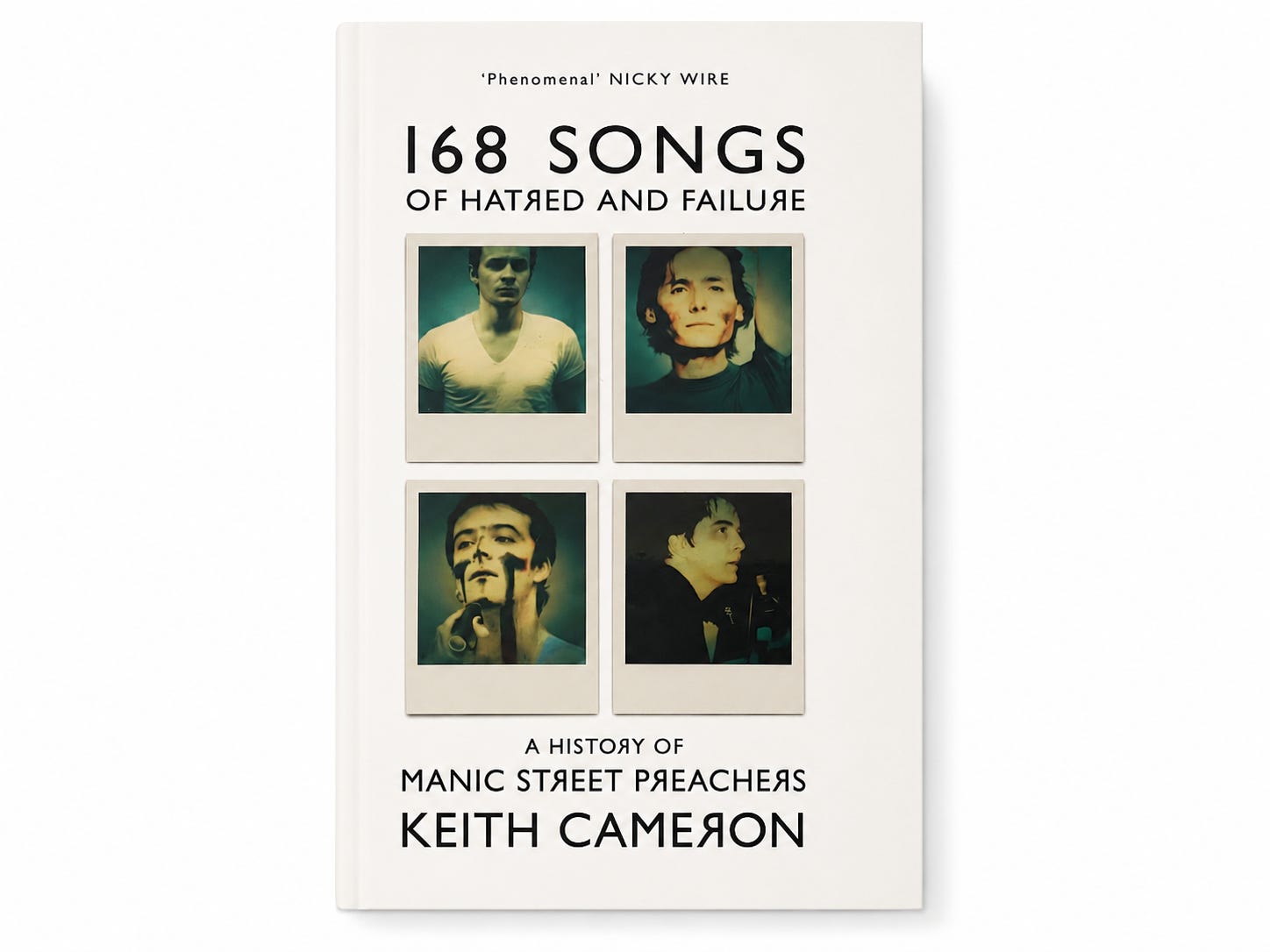
There are two concepts which are central to understanding both the cultural importance and continued appeal of the Manic Street Preachers. The first is the band as "a portal" – a doorway into the vast library of music, literature, art, film and politics that furnished their work. The second is the band as "post-cringe" – able to pursue their art in a manner that can transcend any consideration of what is cool.
Both these ideas are why a book like Keith Cameron’s 168 Songs of Hatred and Failure could be commissioned – where the author examines the lyrics, themes, recording, and context of a selection of the band’s back catalogue. To be a fan of the Manic Street Preachers is not a casual proposition. The band are a culture in and of themselves. They’re not simply a band you listen to, as what is so compelling about the band has often been found beyond the mere sound they make.
Instead they’re a band you live inside. A band guided by their curiosity, ambition, and the dualism of their sincerity and absurdity. Alongside this, their encyclopaedic knowledge of the world-at-large means there are always new clues and paths to follow from their albums and interviews. Unlike most alternative bands who see interviews as forums to be evasive, obscure, and mysterious, the Manic Street Preachers have always been open, honest and forthcoming (as well as combative and funny).
The title of Cameron’s book comes from two sources. The first is from the band’s bassist and lyricist, Nicky Wire – a man always looking for a ridiculous idea for the others to talk him out of – suggesting they should write a concept album to counter The Magnetic Fields’ 69 Love Songs called 70 Songs of Hatred and Failure. This idea aligned with the band’s instinct for agitation, but also with how they understood their own project as a band.
The band’s original manifesto contained the statement that they would never write a love song. To do so would be a waste of a megaphone. The objective of music was to say something extraordinary, not commonplace. To emphasise this, the band’s first significant release was an anti-love kick to the face called Motown Junk. Which announced itself through the opening line:
Never ever wanted to be with you, the only thing you gave me was the boredom I suffocated in.
Motown Junk’s theory was that rather than religion, it was actually the love song that was the opiate of the masses:
Motown Junk – a lifetime of slavery. Songs of love echo underclass betrayal.
Stops your heart beating for 1-6-8 seconds, stops your brain thinking for 1-6-8 seconds.
This is where the number of songs chosen by Cameron to analyse for the book comes from. One hundred and sixty-eight seconds – or 2 minutes 48 – was considered the ideal length of a pop song for radio at the time. As the band has released 319 songs to date, 168 was both a more manageable number, and one of symbolic value.
While as young political agitators, the band saw hatred as a motivating force, they would also consider their career to be a failure. Both in terms of not reaching their objective of total world domination, and through the loss of guitarist and lyricist Richey Edwards, who disappeared in 1995 and has never been found (he was declared legally dead in 2008). Given the band were primarily a close-knit group of friends (a gang before they were a band), this was an existential loss.
This nature of the Manic Street Preachers has been central to their appeal. Four childhood friends from a nowhere town in Wales kicking against the world. The shared lives and worldview, innate understanding and intense solidarity between them was integral to their music – and what has made them compelling beyond their music. They were not a band that could simply replace Edwards with someone else. The friendship was the band. The loss of Edwards was therefore a failure of concept. The three remaining friends continued without him, but the idea of the band was weakened.
The closeness of the friends was what allowed them to pursue a vision that people outside of themselves would find farcical. Following Motown Junk the band felt they needed a song to use as a retort to those who would envy their agitation, ambition and (projected) success. You Love Us was another deliberately confrontational song – a song of exaggerated confidence designed to goad the British music press into paying them attention. To them, it made sense to write such a song before anyone knew who the fuck they were. Eventually everyone would.
The band’s mythology has long been shaped by the idea of the grand folly – the spectacle of overreaching ambition: the attempt to build something vast, world-altering, and impossible, pursued with total sincerity and commitment, but which ultimately fails. The scale of their efforts, the intensity of their belief, and the gap between aspiration and outcomes is both amusing and captivating.
There are few grander follies in music than the Manic Street Preachers debut album – Generation Terrorists. An album that suffered from its bloated tracklist, its incongruous ideas, and shift in the musical culture between recording and release that made it passé as soon as it hit the shelves.
Surveying the musical landscape in early 1991 revealed to the band that punk had limited pathways to selling the 16 million albums they claimed their first album would. To achieve such a feat, the only path was through the United States, and in preceding years it was hard rock that had been culturally dominant. The idea struck them then to try to fuse together the confrontational radicalism of Public Enemy with the American everyman connection of Guns ‘N’ Roses. Big ideas and bigger riffs. To them it was a foolproof combination.
Only by the time the album was released the world had changed. Nirvana had struck, and gone was highly polished, balls-out guitar licks and in was a sound more abrasive and dissonant. Alongside this, there was a new youth posture of being disaffected, detached and authentic. To be cool meant restraint and disinterest. Boasting – one of the young Manic Street Preachers’ great skills – was now deeply suspicious.
Alongside their poor choice of musical style, the band also seemed oblivious to how their local political references could possibly find traction outside the United Kingdom. It is absurd to think that a guy driving his truck through rural Indiana would be singing along to a song about the British banking system called Natwest-Barclays-Midlands-Lloyds. However, the band remained convinced that such an approach would be successful.
When the band did turn their lyrics towards the U.S it was with unvarnished hostility. Songs like Slash ‘n’ Burn and Democracy Coma were never going to connect with people to whom a loyal, uncritical patriotism was an integral part of how they understood the world.
Each move the band made was at odds with what could rationally produce the world domination they sought. But this is also what made them utterly fascinating – an irrepressible will, a romantic idea about what a rock band should be, and a belief that everything was of interest and capable of being incorporated into their world. A band who were both driven and weighed down by their ambition, incapable of connecting their goals to structural realities.
Aside from the mature outlier of Motorcycle Emptiness and enduring appeal of Little Baby Nothing (a song they wanted Kylie Minogue to sing), Generation Terrorists’ legacy lies within its sleeve rather than its sound. Here each song was given a quote to illustrate its theme and place it in a broader political or cultural context. These quotes included authors Philip Larkin, Sylvia Plath, Camus, Henry Miller, and George Orwell, alongside Public Enemy’s Chuck D, and the Sleez Sisters, the fictional band from the film Times Square.
This approach to giving their music a wider context is one they have continued with every subsequent release – albums and singles alike – where there has always been at least one quote from philosophers, poets, actors, politicians, and novelists used to frame their music. It has been one of the central pillars of the band as “a portal”. To the fan, these sleeve quotes act as an invitation into the band’s world. This was especially important for teenagers looking to build their cultural knowledge. It provided both a list of other art to pursue, and made people feel like they were joining a movement with a genuine set of ideas behind it. This is what made the band exciting, and capable of generating a loyalty that could transcend the very uncool sound of their music.
Yet such aspiration for little reward also exhausted the band. There are few bands that have suffered so conspicuously from “second album syndrome”. Rather than adjust to the new cultural environment created by Nirvana, they doubled down. Only this time minus the fist-swinging political missives. As Cameron writes, Gold Against the Soul had the Manic Street Preachers “contemplating subsistence as a moderately successful career rock band”. Gone was the revolutionary fervour, gone was the agitation and spirit, and in its place was a mostly inward-looking album of middling FM rock designed to appease the blandest of radio station programmers and offend no-one.
Where the band did retain some wit and contention it was funnelled into Patrick Bateman, a six and half minute turd-metal epic about the Bret Easton Ellis novel American Psycho (which also managed to squeeze in a back-handed reference to the Happy Mondays’ Shaun Ryder). The song was initially identified to be the album’s first single, but their record company subsequently refused to release it – with its blasphemy being the stated reason, but foresight probably being the more compelling one. Eventually it would appear as a b-side, and earn itself cult status as a song so bad it has a strange magnetic appeal.
Gold Against the Soul was a clear failure, and has mostly been renounced by the band. However, it did have two redeeming features. The first was La Tristesse Durera, a song that demonstrated, like with Motorcycle Emptiness, the band had a genuine talent for a style of melancholic rock that could connect sadness to a hummable tune. With the song being written from the point of view of a World War II veteran, it was also a demonstration of the band’s willingness to transcend political sloganeering and address global affairs in a more sophisticated manner. Particularly through subjects that conventional progressive politics would deem unfashionable.
The second redeeming feature of Gold Against the Soul was that it was a necessary humiliation. It forced the Manic Street Preachers to reevaluate their approach and clarify their purpose. The band had come to the realisation that they had lost their connection to the music they actually liked as teenagers, and succumbed to a lazy mode of operation that reflected the compromises they’d made. These compromises had brought them neither total world domination nor the dignity of a distinct artistic vision. They had to change.
That change was dramatic. Gone was any attempt to make music that could appeal to a broad audience. In its place was an album of jagged gothic post-punk that spat and snarled. An album of dark, concentrated intensity that had the band interrogating the civilisation rot of the 20th Century; its wars, genocides, serial killers and other moral failings, alongside themes of haunting psychological struggle. The album was a bloodied J’accuse to all and sundry. They called it The Holy Bible. A title both consistent with the band’s penchant for provocation, and reflective of the album’s artistic merit.
With Blur following the herds down to Greece, the Manic Street Preachers had again failed to align themselves with the cultural moment, yet this time it was intentional. The album was a hand grenade hurled into Britpop’s cosy enclave of self-regarding nostalgia. Its thesis was that the 20th Century had lacked a true accounting of its atrocities and enormous cultural changes, moving instead into a comfortable post-Cold War triumphalism. The Holy Bible’s cultural affinity was to be found not within the field of music, but with Eric Hobsbawm’s The Age of Extremes – the historian’s overview of the period between 1914-1991 – which was released serendipitously almost simultaneously with the album.
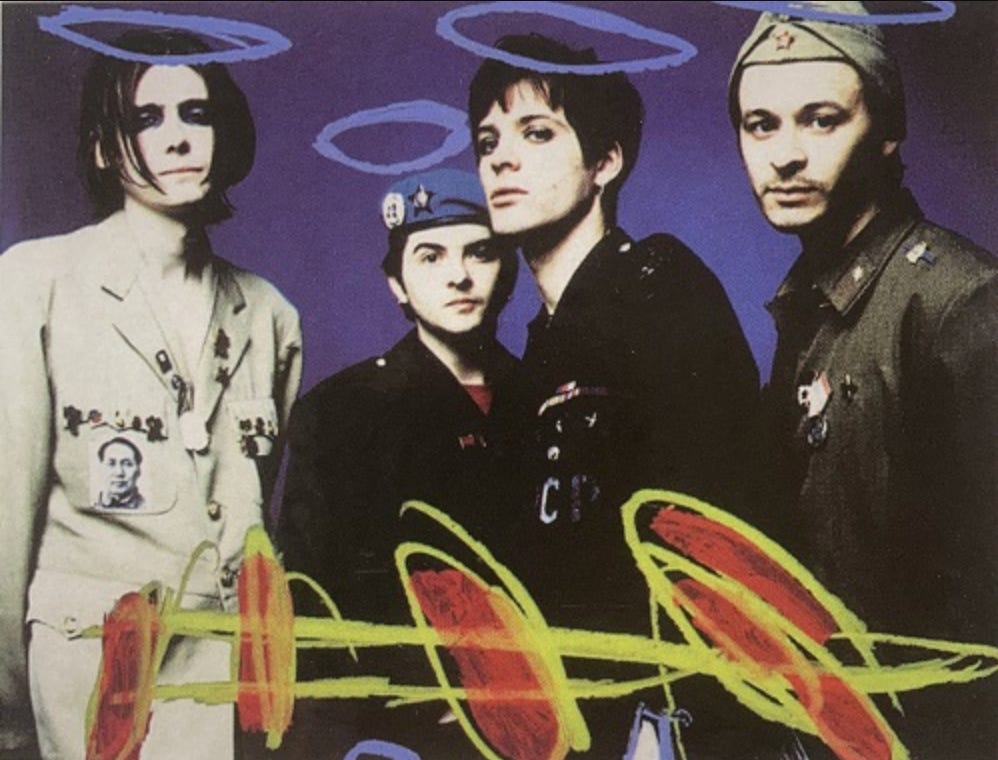
Unlike other bands who would use touring Europe as an opportunity to sample the local inebriates, the Manic Street Preachers had instead taken the opportunity to visit the former concentration camps in Dachau and Belsen. This experience led to two songs on the album about the Holocaust – Mausoleum and The Intense Humming of Evil – with Mausoleum’s coda containing what would be the album’s guiding philosophy, a sample of J.G Ballard describing his book Crash – I wanted to rub the human face in its own vomit, and force it to look in the mirror.
The Holy Bible’s overarching theories of the century’s brutality came via Of Walking Abortion and Archives of Pain. The latter’s argument was that there lay a lust for, and fascination with, violence deep within humanity’s soul, and the appetite for the rehabilitation of criminals is a sentimental lie that betrays the victims of violence. While rehabilitation may seem politically noble, it actually functions as a form of forgetting, making society more vulnerable to our violent lusts. The song is embellished through a sinister bass line, an escalating and intense instrumental outro, and a truly bonkers chorus that simply lists the names of mass murders and vicious political leaders (replacing Milosevic with Manic Street Preachers the second time it comes around).
Yet Archives of Pain was not alone in confronting progressive shibboleths. Through P.C.P the band critiqued what was then called “political correctness”. The song argued that such a social management system was driven by what Edwards called in his explanatory notes distributed to journalists as the “New Moral Certainty” – a conviction that has only intensified since. The negative effects of such linguistic policing and moral posturing were predominantly worn by both the working classes and those groups who these social rules claimed to be protecting.
It’s a song that continues to offend modern analysts of the album. As what the song demonstrated was the band’s stubborn streak of intellectual independence, and the sharp disconnect between their own socialism – rooted in the mining towns of the South Wales valleys – and the costuming of middle class progressive politics.
Yet the album’s legacy has been less tied to the political lessons of the 20th Century (lessons we’re now failing to heed), and more to the bleak emotional difficulties of its chief lyricist, Edwards. Prior to the album’s release he had been admitted to a mental health hospital, and songs like 4st 7lbs and Die in the Summertime were clear indications of his deterioration. Even the extraordinary boast of the album’s lead single Faster (that is, one who fasts) – I am stronger than Mensa, Miller and Mailer, I spat out Plath and Pinter – was indicative of the very opposite.
Six months after the release of The Holy Bible, in February 1995, Edwards and singer/guitarist James Dean Bradfield were due to fly to New York for a promotional visit, instead Edwards left the London hotel where they were staying prior to departure, drove back to Cardiff where he left some items in his flat, and then remained undetected for two weeks before his car was found with a dead battery at a service station near the Severn Bridge crossing between England to Wales. There has been no trace of him since.
After six months of contemplating their continued existence as a band, out of habit Wire gave Bradfield a pair of lyrics, and Bradfield concluded they were both on a similar theme and decided to fuse the two together in order to construct some music. The process was an attempt to create some normalcy during a deeply traumatic period. Yet the result was spectacular, and something the band felt needed to be heard.
A Design for Life was driven by what Wire saw as Britpop cosplaying and commodifying British working class culture. The song was a vast, poignant hymn to the band’s own origins. It was also the sound of the band stepping out of the twin shadows of The Holy Bible and Edwards’s disappearance, and in doing so, achieving something that had previously eluded them – a massive hit single.
The subsequent album, Everything Must Go, produced another shift in style – more expansive and melodic, with an overarching sentiment that Bradfield would describe a “wistful resistance” – a form of euphoric melancholy that the band would come to perfect. All four singles from the album reached the top ten of the British charts, and the album would be certified as triple platinum. Although traction in the U.S continued to elude them, Everything Must Go would transform the band from cult curios into one of the United Kingdom’s biggest bands.
Yet this success was clearly bittersweet. The disappearance of Edwards was not simply a personal tragedy but a rupture at the very heart of what the Manic Street Preachers were – a band built on a deep personal bond between four lifelong friends. Music was the vehicle to express this bond, it wasn’t a bond established by the band. For Edwards to not share in their success diminished the ability to take full pride and celebration in their work.
Yet Everything Must Go was not without Edwards’ input. Five songs on the album featured lyrics written by him. These included Kevin Carter – a portrait of the Pulitzer Prize winning South African war photographer who committed suicide after being unable to cope with what he had witnessed (and been rewarded for). As well as the gorgeous Small Black Flowers that Grow in the Sky, a song ostensibly about animals in captivity – written after Edwards had watched a documentary on the state of Britain’s zoos – but which could also be interpreted as being an analogy for his own time in a mental health hospital.
What the band had achieved with Everything Must Go was distinct from their early conception of what success would look like. There was no accompanying youth revolution, it didn’t bring down the British monarchy, and there were no American stadium tours. Yet it did generate enough interest to demonstrate that the band’s irrepressible will was capable of finally connecting with the broader British public, and doing so while overcoming great personal loss.
This new connection with mainstream audiences offered the band an opportunity to place their ideas into the public consciousness. Which initially they understood. If You Tolerate This Your Children Will Be Next drew upon George Orwell’s Homage to Catalonia, with Wire contemplating whether he would have the courage and be prepared to make the necessary sacrifices to fight against fascism in the Spanish Civil War – or any modern equivalent. Despite its subject matter and its blunt and unwieldy title, the song became the band’s first number one single.
Yet the subsequent album – This Is My Truth Tell Me Yours – failed to capitalise further on this opportunity. It was again an inward looking album, often far more concerned with Wire’s domestic world than political commentary. Where this worked well, like with Black Dog On My Shoulder, it was exquisite, yet much of the album felt resigned, timid and insipid. When Wire sought to make a bold statement through S.Y.M.M (which stood for South Yorkshire Mass Murderer) the lyrics were a weird metacommentary about writing a song about the Hillsborough Disaster, rather than directly addressing the administrative neglect that created the tragedy.
The overly earnest album title was taken from a speech by the founder of the NHS, Welsh Labour politician, Aneurin Bevan. It symbolised a conscious choice to connect more overtly with Wales. Songs about the flooding of the Tryweryn Valley to create a water reservoir for Liverpool (Ready for Drowning) and the Welsh sisters known as the Silent Twins (Tsunami) were expressions of this new interest in their country, but they were rare outward-facing songs.
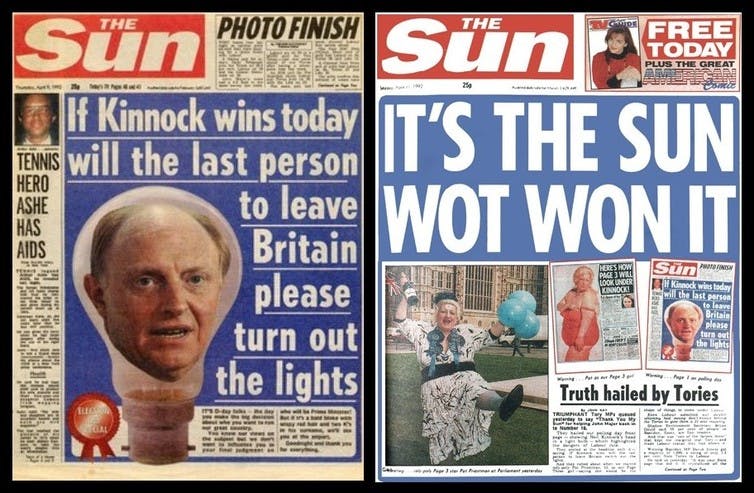
This expression of Welshness was something that Edwards had previously resisted, wishing to avoid what he called “the Kinnock factor”, the certain demeaning attitude towards the Welsh, and the perceived unelectability of former Labour Party leader, Neil Kinnock. This was exemplified by The Sun’s infamous headline on election day in 1992 “If Kinnock wins today will the last person to leave Britain please turn out the lights.” The idea would stick with Wire as one that may have been the cause of their lack of early success.
The band had initially attempted to record a far more upbeat record with a producer whose background was in electronic music. Yet these sessions were not deemed successful and were abandoned. However, songs from it would surface as b-sides, with one, Prologue to History, beginning with the line – Were we the Kinnock factor? Driven by an Italo-House piano line, it was notable for its stream of references from Shaun Ryder (again) to British middle distance runner Steve Ovett. Despite being discarded as a b-side it earned a full page spread in Select magazine explaining its details.
Such interest in the band was indicative of their newfound success. Despite the languid nature of This Is My Truth Tell Me Yours it matched the sales of Everything Must Go. Yet, there was a palpable sense that the band had lost their verve and spirit. Much of this had previously been supplied by Edwards, yet it was also the nature of success. Rather than success facilitating the fantasy of tearing down establishments – as they had conceived in their youth – success instead draws you into a cultural machine, presenting you not with freedom but with compromise.
In an attempt to reset and reclaim their edge, the Manic Street Preachers embarked on what could be seen as their grandest of follies – a concert in Havana. Cuba offered the romance of resistance – revolutionary iconography, anti-American defiance, the illusion of authenticity untouched by Western commercialism. The band had used the Cuban flag on their limited-edition turn-of-the-century single The Masses Against The Classes – a song less political statement and more a petulant response to those suspicious of their success. Cuba symbolised where the band felt more comfortable – as pariahs rather than as parishioners.
Yet the trip to Cuba was a familiar artistic temptation: the belief that a proximity to “history” or “revolution” can restore a sense of purpose and radical idealism. Instead, the band found themselves playing before Castro and being absorbed into the theatre of his regime’s propaganda. Rather than restore the band’s insurgent energy, they sold themselves to a political system they only partially understood. In the process, revealing how vulnerable artists are to political mythmaking and the allure of authoritarian state power. This would be subsequently acknowledged over a decade later on the song The Next Jet to Leave Moscow from their Futurology album.
The attempt to reclaim their youthful spirit via a new album was also an extraordinary failure. Named Know Your Enemy – a phrase generally traced back to Sun Tzu and The Art of War – and leading with Found That Soul, the album was both trying too hard to prove itself and a sprawling, incoherent mess of musical styles and weak subject matter. Where the band’s best albums – The Holy Bible and Everything Must Go – had a tight focus and consistency of both sound and vision, Know Your Enemy was the work of a band lacking in aim and purpose, or, like the trip to Cuba, actively seeking to detonate themselves.
Oddly, the album’s one great triumph – So Why So Sad – has become a song the band have disowned, seemingly disappointing by its lack of public traction, and the confusion created by writing the best Beach Boys song since the late-1960s. An occasionally lazy lyricist, So Why So Sad is one of Wire’s finest lyrics – subtle, not overreaching and paying close attention to each word, as he explored the duality of his personality as both an enfant terrible and lethargic homebody. The song itself is an exquisitely crafted gem, and a demonstration that the band’s musical imagination could extend beyond the guitar.
If Know Your Enemy was utterly baffling to the fanbase who had come onboard through Everything Must Go and This Is My Truth Tell Me Yours, the band weren’t finished confusing people, and orchestrating their own decline. After their longest break between albums, the band reemerged with an electro-pop song called The Love of Richard Nixon. While the song title continued the band’s fondness for provocation, it was also borne from a fascination and studied interest in grand historical figures, and especially an interest beyond their headline reputations. The band have never been shy about trying to establish a public connection with unusual material – as hit and miss as this had been for them.
There was also a certain affinity between the Manic Street Preachers and the former president – both emerged from modest circumstances and were driven by a force of personality that willed their place in history into existence. Yet success, for each of them, coexisted with a persistent sense of visions unrealised and ambitions thwarted, alongside the obvious penchant for self-sabotage. The lyric “the times they fall behind you” could apply as readily to themselves as to Nixon – particularly during The Holy Bible period, where the band’s diagnosis of the world now looks prescient.
Prescient could also describe the subsequent album, Lifeblood. Despite its commercial failure, history has been far kinder to it, with a sound more aligned with the musical culture two decades on. The album was also more focused musically, built around sleek synthesised textures, controlled atmospherics and a coherent emotional tone that deliberately set it apart from the era. It was an album designed for a night home alone, rather than a night on the town.
Like The Holy Bible’s rejection of Britpop, here Lifeblood was a rejection of the prevailing musical culture of the early-2000s. A time when guitar music was increasingly defined by the retro-rock revivalism and laddish hedonism of bands like The Strokes and The Libertines – what is now labelled “indie sleaze”.
Despite the band’s long-cultivated image of provocation and fondness for rock ‘n’ roll mythology, genuine hedonism had never interested them; if anything, a deep suspicion towards those pursuing pleasure too enthusiastically had always sat at the centre of their worldview. The band’s rhetoric and public image were often at odds with their actual character: beneath the slogans, eyeliner and confrontational posturing sat a sensibility heavily rooted in the mining communities of the Welsh valleys – hard work, personal restraint, respect, helpfulness, loyalty and politeness. They are quite possibly the only rock band to whom punctuality is a core tenet.
These – now former – mining communities of South Wales are not just central to the band’s origins, but their origin story. The defining event of their teenage years was the Miner’s Strike of 1984-85, which hit South Wales with particular intensity – with mine-dependent communities facing an existential struggle against pit closures and state restructuring. This was not just an industrial dispute between the British government and the National Union of Mineworkers, it was a social rupture that was cultural as much as it was economic.
Coal mining had been central to the livelihood of the region since the late 17th century, embedding itself deeply into the fabric of South Wales. It fostered tightly bound communities defined by deep solidarity, where toil, workplace risk and mutual social dependence shaped everyday life. There was a powerful sense of collective pride in having fuelled the Industrial Revolution – a pride not from wealth or personal status, but the collective social esteem that the physical labour of the Welsh coalfields underpinned modern Britain’s industrial rise. What the government offered in replacement – the Pot Noodle factory – offered no such dignity.
The first song that Wire and Bradfield wrote together as teens was called Aftermath – a commentary on the Miners’ Strike. Ever self-referential, Lifeblood’s opening track was called 1985 and was a song about this first song. Yet 1985 is also about the cultural environment of the time, with references to The Smiths and Torvill and Dean. In interviews for Cameron’s book, Wire remains convinced that 1985 was music’s greatest year, and the song is more of a lament for his teenage years which offered both a social struggle and a vast cultural menu for inquisitive young minds.
The band have often discussed their blissful childhoods, and this has informed a sense of loss as a central theme of their work. The brutal economic change of South Wales, the broader rapid social and cultural change of the past forty years, and, of course, the disappearance of Edwards. Wire had skirted around the issue in several songs, but it wasn’t until writing Your Love Alone Is Not Enough did he address his feelings directly.
The song is blunt in asserting that Edwards owed them something more than just love, he owed the band his presence. An assertion that friendship was a shared commitment to lows, not simply revelling in highs, that Edwards didn’t acknowledge what he had – the privilege of a lifelong bond that offered unconditional support. The song also happened to be phenomenally catchy – enlisting The Cardigans’ Nina Persson for a duet – and revived the band as a popular success.
In 2008, Edwards was declared legally dead. The law in the UK stipulates that after seven years a missing person can be declared dead, but his family and the band had delayed this decision in hope that he might resurface. The band had continued splitting their earnings four ways, even on records that Edwards hadn’t appeared on, in case he did reappear he would have a considerable sum to live off. The official declaration of his death allowed this money to be released to his family.
Yet the declaration also allowed the band to enlist Edwards again as a songwriter. A few weeks prior to his disappearance, Edwards had given the rest of the band a binder of new lyrics. Those that had already been turned into demos – and Edwards had heard – appeared on Everything Must Go, but the other lyrics the band felt they shouldn’t touch. However, they now revised this decision, feeling it was time to give him a proper send off with a new album constructed with his input.
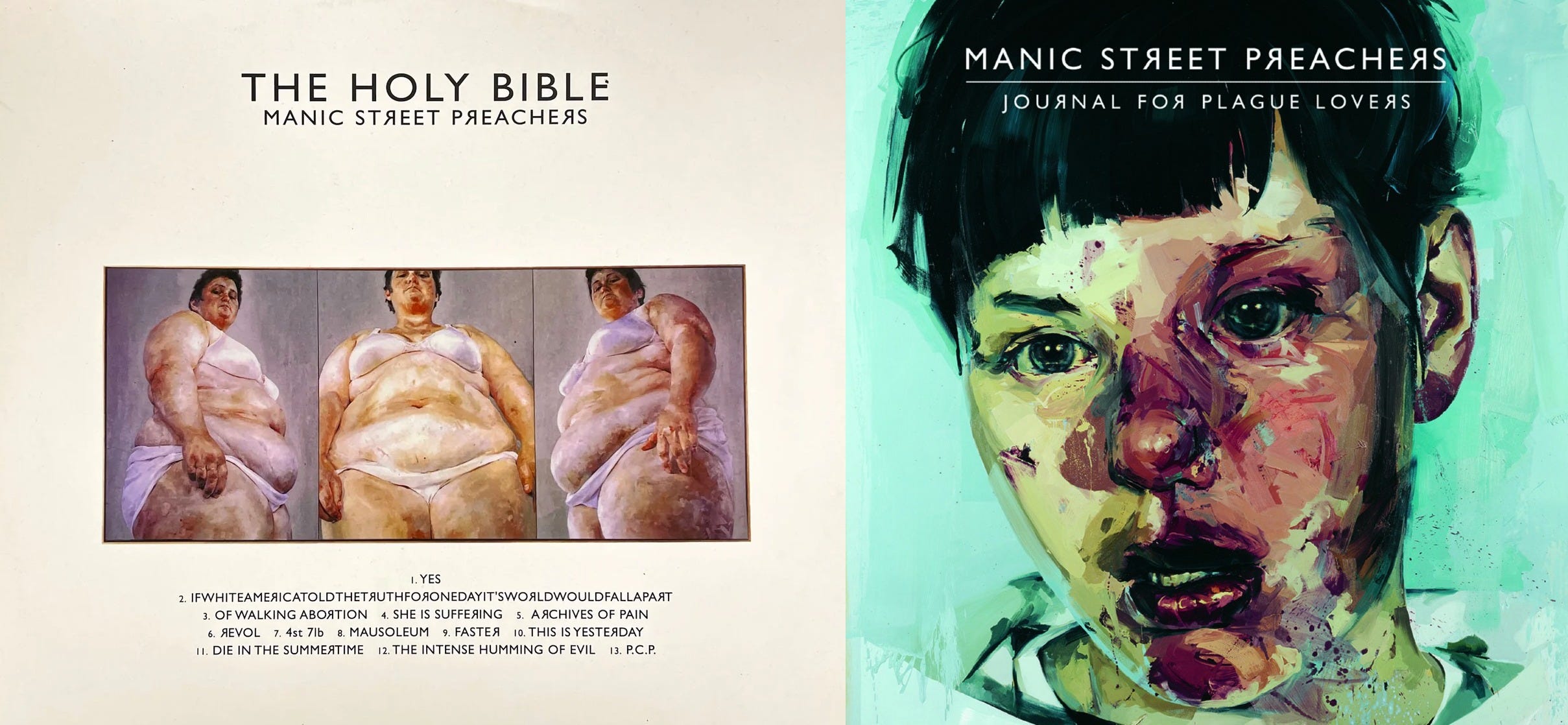
The nature of Edwards’ lyrics lent the band to revisit a sound adjacent to The Holy Bible, and they actively sought a visual symmetry as well. Whereas The Holy Bible had featured a painting by Jenny Saville called Strategy (South Face/Front Face/North Face) as its cover image, they returned to Saville again who supplied them with Stare for Journal for Plague Lovers. The band also used the same typeface, and the backwards Rs they had used in 1994 (itself a device borrowed from the Simple Minds album Empires and Dance).
Several songs concern Edwards’ time in a mental health hospital, and in particular his critique of the 12 Step Program and its religious themes. However, rather than entirely bleak, the album also deploys absurdist humour. Jackie Collins Existential Question Time – “Oh Mummy, what’s a Sex Pistol? – and Me and Stephen Hawking – “We missed the sex revolution, when we failed the physical” were both wry in a way that suggested that Edwards hadn’t entirely succumbed to despair.
Yet themes from The Holy Bible did reappear, notably on This Joke Sport Severed, the sister song to She Is Suffering. The “she” in this song was a metonym for “desire” and the song concerns Buddhism’s Four Noble Truths – the first two are that life involves suffering, and that it is desire that is its root cause. The song interrogates the darker mechanics of male sexuality, and its psychological hold on masculinity.
If She is Suffering was Edwards contemplating the first and second noble truths, then This Joke Sport Severed was him moving onto the third – to actually follow the logic through, and attempt the radical disconnection from human relationships that monks and ascetics have always understood as the only clean solution.
Yet through the song Marlon J.D there is a recognition that such clean solutions also come with costs. The song is written about Marlon Brando’s character in Reflections in a Golden Eye; a man whose rigid self-discipline is itself a prison. Edwards’ fascination with self-denial was apparent through a song like 4st 7lbs off The Holy Bible, yet the film itself demonstrates the pressure that builds – and ultimately bursts – from such austerity. And ultimately it did for Edwards too.
While it was one of the band’s more stylistically consistent and better albums, Journal for Plague Lovers also revealed a tension that had appeared during The Holy Bible. Although that album’s artistic merit made it a record of enormous cultural importance, writing music that served the nature of Edwards’ lyrics moved the band into terrain that made their mission of “mass communication” more difficult.
Following the darker style of Journal for Plague Lovers, the band returned to trying to write a widescreen, continent-sized radio anthem through (It’s Not War) Just the End of Love. A song that sought to embody the “euphoric melancholy” that had been central to their biggest hits. It was an attempt to reassert themselves as a band that could reach a broader audience.
Ordinarily this approach would mark a band as “uncool” in more musically discerning circles. Indie cool runs on a set of unspoken rules: understatement beats enthusiasm, obscurity beats popularity, and trying too hard is sin. Authenticity is everything, even though this produces its own performative behaviour. The in-group is maintained through the cultivation of taste and the signal that there are those who “get it” and those who don’t.
Modern progressive cultural politics imports this same psychological structure. Persuasion gets treated as pandering, big-tent messaging as a sell-out, and an attempt to speak to a larger constituency is seen as a compromise. Just as an indie band loses credibility by chasing a wider audience, a progressive political position loses credibility by being too broadly acceptable. The attempt to convince people becomes evidence of inauthenticity.
The Manic Street Preachers were built on a complete rejection of this thinking. To them, both music and politics was about mass participation. They were about having the communication skills to reach and convince people that something is of worth. While this approach may seem uncool to those who prioritise exclusive scenes or niche ideas, the band’s roots in the Old Labour culture of the Welsh Valleys gave them an instinct that persuading a large constituency was the whole point. The internal rules of indie scenes and modern progressive cultures seemed small in comparison.
Yet also central to the band had been the idea that the mainstream audience can handle bigger ideas in their pop music, and to recognise that being exclusive is actually a form of condescension. The band’s operating principles have been to be open to understanding all culture, to not be snobbish, to be curious, and to find something to appreciate in everything. Their attempts at “mass communication” were often spectacular failures, but the striving was genuine and generous.
This is what made the band “post-cringe”. They simply exist outside of the rules that constrain other bands. Part of this has been what Cameron describes as the “quintessentially Manics mangling of intent and outcomes,” which has been part of their charm, and what has allowed people to give the band a leeway to fail. The scope of the band has always made them worth more than the music alone.
This scope is what allowed them to write and record two completely distinct albums simultaneously. Two albums that highlighted the duality of the band. The first – Rewind The Film – was a paean to Wales, a predominantly acoustic and downbeat reckoning with ageing, loss, nostalgia, and the landscape of the valleys that made them as people.
It was a mostly inward-facing album, yet also contained a glorious burst of exuberance called Show Me The Wonder – a song that could be seen as their operating system. Four working-class kids from Blackwood hungry for music, literature, art, film and politics – it is a song that captures the band’s core conviction that curiosity is not a phase you grow out of but a discipline you maintain. That the simple act of paying attention to the world was both a requirement and a reward.
The second album – Futurology – was outward-facing, a love letter to European culture and political identity. Drawing upon the motorik rhythms of Krautrock and with the influence of electronic post-punk, it is – alongside The Holy Bible – the band’s most musically interesting album. Its idea was to be a statement of Britain’s European connection at a time when the UK was moving towards the self-destructive detachment of the Brexit referendum.
Although the album is often let down by lyrics that are trying too hard to fit the album’s intent, one song that avoids such a problem is the instrumental Dreaming a City (Hugheskova). Although musically a homage to Simple Minds Theme for Great Cities (albeit with some additional prog elements), it is the title of the song that is most intriguing.
Hugheskova was founded in 1869 by John Hughes, a Welsh ironmonger from Merthyr Tydfil – just up the road from Blackwood. Hughes had secured a contract to establish coal and steel works in what is now Ukraine’s Donbas region. The settlement that grew around his iron factory was initially staffed by workers recruited from South Wales. The city was renamed Donetsk in 1961 and grew to become Ukraine’s fifth largest. It is currently occupied by Russia.
Whereas Rewind the Film had looked back at the local platform on which the band were built, Futurology looked forward and outward, towards Berlin, towards the European modernist tradition, toward the idea of the continent as a shared intellectual and political project. The two albums together could be seen as forecasting the rise of Plaid Cymru as now the largest party in Wales – a party staunchly committed to the Welsh nation, yet also keen for Wales to rejoin the European Union.
Upon its formation, the EU chose the shade Reflex Blue as its representative colour as it carried no single nation’s associations. It was the colour of the ocean and the sky, it felt collective and beyond political structures. To the naked eye Reflex Blue and International Klein Blue are incredibly similar. Developed in 1960, Yves Klein had believed his shade of the colour dissolved the boundaries between the physical world and the transcendent, it was the colour that humanity lived inside, connecting generations and cultures.
For a band to whom “everything” has been their animating force, International Klein Blue carried with it a sentiment that clearly required a song. In a latter period where the band struggled to maintain consistency, International Blue, from the album Resistance is Futile, was a triumph. An uplifting slice of power-pop that took a concept that could otherwise feel distant and abstract and gave it warmth and a racing pulse. At their best, this was the Manic Street Preachers singular gift – the ability to find what may be an obscure idea and make it feel like it belonged to everyone.
Wire developed a niche for writing songs about artists – from Interiors (Willem de Kooning), To Repel Ghosts (Jean-Michel Basquiat), Black Square (Kazimir Malevich), Between the Clock and the Bed (Edvard Munch) and The Secret He Had Missed (Augustus and Gwen John). It was a demonstration of the portal evolving with age, still fascinated, still searching for ideas that can be converted into their own art. Still seeing the band’s mission as conduits.
It is this conception of the band as conduits that drives Cameron’s 168 Songs of Hatred and Failure. The unconventional structure of the book – navigating the band song-by-song – provides an accumulation of intimate details, rather than just the headline-grabbing moments, to create a fuller portrait of both their work and who they are as people. Cameron understood that the band’s follies and failures are not embarrassments to be explained away but the very substance of what made them worth writing about.
This is ultimately what has been central to the band’s appeal – not simply the music, but an investment in a particular way of moving through the world. An insatiable curiosity, a conviction that culture has no hierarchy, and the audacity to think that four boys from a small town in South Wales could create something world-altering.
Yet it has also been the contradictions at the band’s core that made them genuinely compelling – socialists with a fiercely independent streak, antagonists who were honour-bound to the courtesy and decency of the Welsh valleys, intellectuals who believed in pop and the importance of speaking to everyone. And an intensely loyal group of friends who were able to use their collective abilities to create an improbable artistic force, yet through the disappearance of Edwards were unable to remain fully together.
All of this – the contradictions, the aspiration, the follies, the success, the devastation – coheres into a single moment on Still Snowing in Sapporo, the opening song from their fourteenth album. Documenting their first trip to Japan, the song is a neat encapsulation of the band: an awkward, cringey verse coupled with a chorus you can see from space. An acknowledgement of the ambition they could never quite meet, the enormous loss they have carried, and the implicit recognition of the magnitude of what they had actually achieved.
The song concludes with the same immense idea that drove them as teenagers – “the four of us against the world.”