

This is a short op-ed written with the hope of being published in the Australian Financial Review or the Melbourne broadsheet The Age. I got no response from either, but I think that is more a problem with the ideas they choose to publish, rather than the writing. So I thought I’d publish the piece here. It is obviously aimed at an Australian audience, but it has some universal themes for most Western countries at present.
Australia’s success as a country has been due to our high level of social trust. No society is without its problems, but we have far fewer than most because even as we’ve become a multi-ethnic society, we have maintained our ability to cooperate honestly and openly with each other.
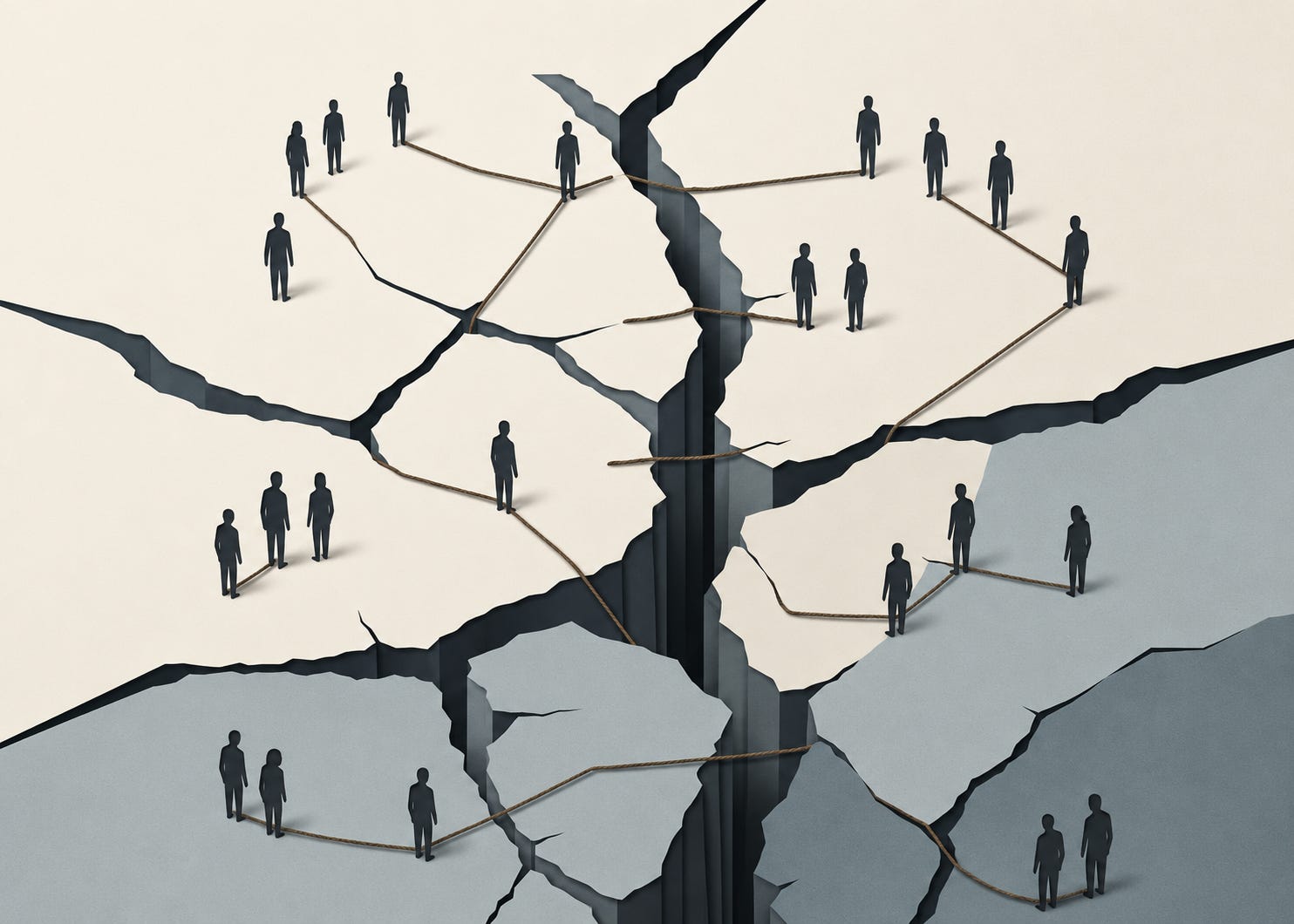
Low-trust societies tend to rely heavily on kinship and ethnic ties, and maintain deep suspicions of those “not like us”. High-trust societies can interact confidently with those outside their immediate groups. They are more able to sustain the rule of law, create prosperity through productive markets, and build strong civic organisations that can flourish without state control. High social trust is liberal democracy’s load-bearing wall.
But this trust is now under threat.
The threat to Australia’s social trust is coming from two forces that believe themselves to be the opposite, but are actually similar.
The first is the rise of One Nation as a major political force. One Nation believes trust comes from cultural familiarity and that this familiarity is inherited through race. Therefore demographic change is seen to be undermining their idea of the country and its operating system.
The party believes it aims to preserve cohesion, yet its idea of ‘us’ is a narrow and hierarchical one. Its political tactics have followed accordingly – driven by the instincts of low-trust societies; reducing Australian society to a permanent contest between insular groups suspicious of one another.
The second threat to our social trust comes through postmodern progressive politics.
Multiculturalism began as a belief that people from different backgrounds could cooperate as equals within a shared civic framework while maintaining elements of their distinct cultures. Here in Australia, this has proved incredibly successful. But progressive politics doesn’t take success well. There is always an impulse to find new problems. Or, create them.
This has led to a bastardisation of multiculturalism, where instead of equal participation in a shared civic community, society has become viewed through ethnic power relationships. This has encouraged people to think about themselves primarily as an ethnicity, with historical injustices weighted onto them from birth. Progressive politics has abandoned a class-based view of society and adopted a race-based one (alongside other new identity groups).
The result is a worldview akin to One Nation’s where society is interpreted as a zero-sum struggle between ethnic groups rather than good faith cooperation among citizens. Which leads to one of the great ironies of our time, as Pauline Hanson is clearly our wokest politician – advocating for a “culturally safe space” for Anglo-Celts.
What is most dangerous is that these political narratives are self-reinforcing. The more Hanson talks about Australia needing to become a “monoculture”, the more it feeds into the obsession with racial power and oppression that progressive politics is mired in. This all pulls Australian society away from seeing each other as fellow citizens with shared responsibilities.
And it corrodes our social trust.
It also entrenches political division on top of ethnic division. Here we run the risk of further importing American-style polarisation into both our political system and daily social interactions. One of the great bulwarks we’ve had against social division in this country has been our weak political identities. No-one calls themselves after a political party the way Americans call themselves “Republicans” and “Democrats”, even if we may vote for the same party at each election.
This has allowed us to see ourselves as something bigger than partisan political actors. It’s allowed us to cooperate confidently because no-one walks around advertising their political allegiance as central to their being. No-one knows who you voted for, and it doesn’t matter anyway for our daily interactions.
Yet an intensified political arena risks changing that. It risks putting both political identity and ethnic identity at the centre of our social lives. It risks making Australia a more suspicious, cynical and ultimately a more dangerous place.
None of this is fixed yet. We don’t have to succumb to becoming a low-trust society. But resisting this requires leadership that is absent at present.
The Coalition looks to be opting out of the political system altogether, simply moving over and allowing One Nation to replace them. While Labor lacks the communications skills to explain to the public just how dangerous One Nation are, as well as lacking the intellectual fortitude to avoid being drawn into postmodern progressive narratives themselves.
If there was a time for some real clarity about what we have here in Australia, it is now – to understand how fortunate we are to live in a country where our problems are policy-related, not deep-seated cultural animosities. Economies, the rule of law, and civic life all rest on the same foundation of trust. We cannot be complacent about what may happen if this trust collapses.