

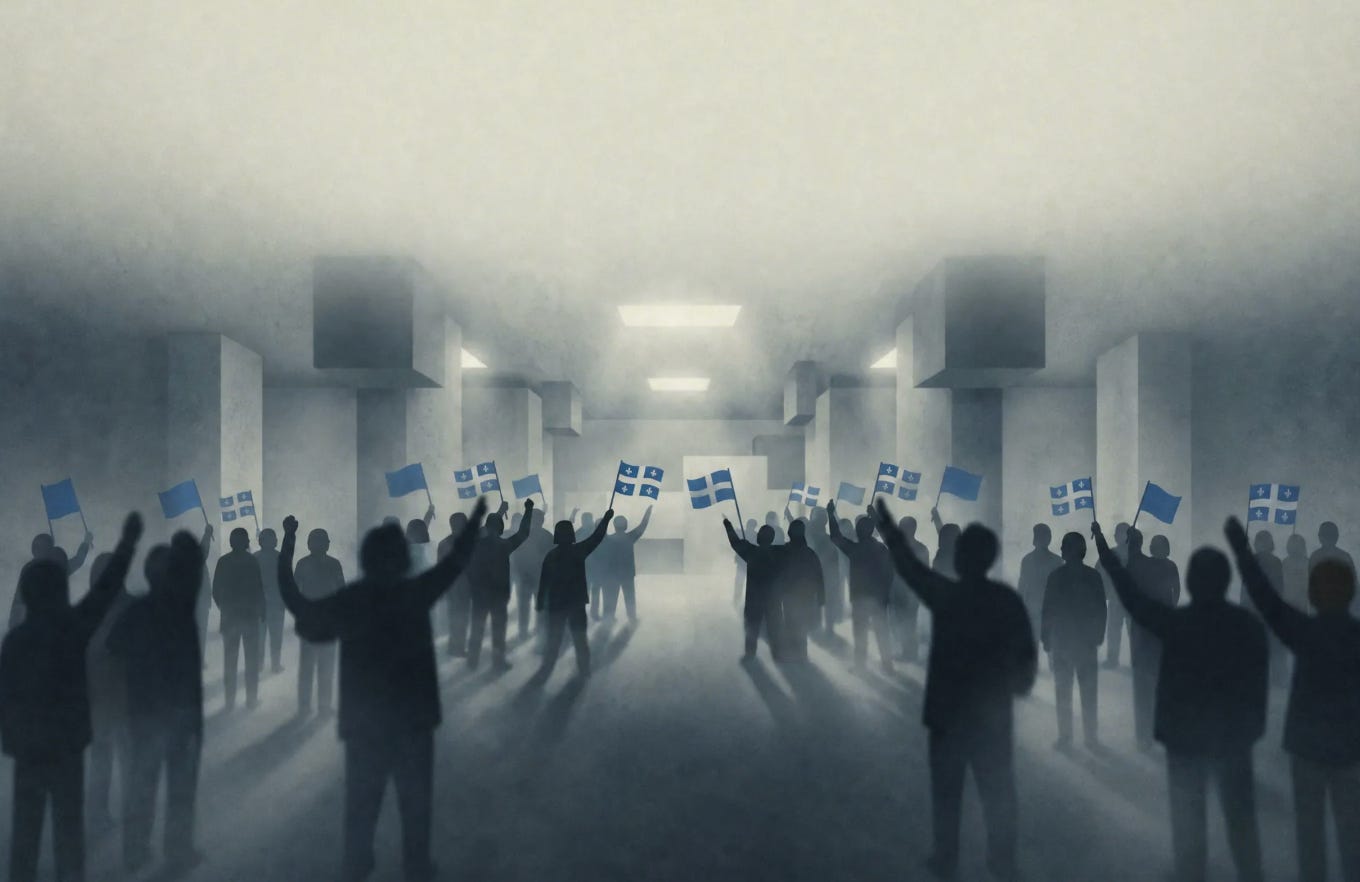
“I am treated and considered a head of state.”
This was a statement uttered by Paul St-Pierre Plamondon, the new premier of Quebec, at the recent summit of La Francophonie in Cambodia. He was asserting that as Quebec has full membership of the organisation, this places the Canadian province on equal status to sovereign states. That neighbouring New Brunswick and Belgium’s Fédération Wallonie-Bruxelles also have full membership dampens Plamondon’s attempt to elevate himself to the head of an independent republic. However, his statement reflects the maximalist tactics he has employed since taking office.
Plamondon leads the separatist Parti Québécois (PQ), whose raison d’être appeared to have been rejected by Quebec voters in 2022, when it won just three seats in the National Assembly. However, under his leadership, the party has been resurrected, winning October’s provincial election. Yet, with five highly competitive parties exposing the shortcomings of the first-past-the-post voting system, the PQ has formed government with only 28 per cent of the vote, albeit falling four seats short of a majority. This is roughly in line with the proportion of people in Quebec who currently support independence.
Despite his weak mandate, Plamondon has immediately sought to challenge the limits of provincial power within the Canadian federation. He requested the lieutenant governor (Canada’s equivalent of an Australian state governor) to not attend the swearing-in of his cabinet. The head of the bureaucracy conducted the ceremony instead, with the lieutenant governor signing the documents privately afterwards. He has further stated he wants to abolish the British Crown’s representative in Quebec, without saying who would perform the office’s duties.1
The previous Coalition Avenir Québec government legislated that pledging an oath of allegiance to the Crown could be optional for taking a seat in the National Assembly. All incoming members – from all parties – chose instead to pledge their loyalty to the Quebec people. However, the Quebec Superior Court has ruled that this is unconstitutional. The parliament is scheduled to sit on 1 December, but at present no members are eligible, creating a constitutional crisis. One that Plamondon looks keen to exploit.2
Prior to this, Plamondon has also sought to challenge Ottawa’s jurisdiction by asserting that Quebec should have its own seat at the negotiating table when international trade affects its economic interests, seeking to undermine Canada’s constitutional role in negotiating international trade agreements. This became contentious during the Canada–EU summit in Montreal in October, as he refused to attend when denied an official address to the summit. He has since written to 59 newly elected American governors and senators seeking direct trade cooperation.
These moves are not as erratic as they may seem. With just 28 per cent of the vote, Plamondon cannot advance sovereignty through the front door. Canada’s Clarity Act on provincial secession requires a clear majority answering a clear question, and he is nowhere near a mandate for another referendum.
So he is seeing how far he can push the federal government instead. A “head of state” title, a cabinet sworn in without the Crown’s representative, letters to American legislators, and now the constitutional conflict over the oath of office: each attempts to normalise Quebec acting as though it were sovereign. They also cost the PQ little, because any objection from Ottawa feeds the grievance on which the party depends.
Yet it is one of the PQ’s central policies that reveals the true nature of the party and what it seeks. The new premier is seeking to cut the number of migrants moving to Quebec, as well as limit the number of international students studying in the province – a move targeting Montreal’s two large English-language universities, McGill and Concordia. The party wishes to reduce Quebec’s intake to 35,000 people a year. Neighbouring Ontario took almost 170,000 people last year.3
Quebec has greater authority than other provinces to select economic migrants – and can select on the basis of capability to speak French – but the PQ’s suspicion of migration is driven by the party’s independence mission, and how the party understands Quebec as a cultural entity.
Quebec’s French-speaking population descends largely from a relatively small number of settlers from France, who, up until the 1960s, had incredibly large families. The Catholic Church had an enormous hold on the society, and the province’s birthrate was 5.4 children per woman in the early 20th Century (and above 6 previously). This was known as la revanche des berceaux – the revenge of the cradles – a belief that Francophone Canada could survive and thrive alongside the country’s English-speaking majority by outbreeding it.
These large families created an expanding network of cousins and an intense solidarity within Quebec society. However, the collapse of the birthrate beginning in the 1960s – to now just under 1.4 – has created an existential crisis within the province. The PQ was founded in 1968, just as the cradles began to empty, and its nationalism has never shaken the anxiety of its own birth.
With a fertility rate well below replacement level, Quebec depends on immigration to sustain its population. This should offer an opportunity to create new French speakers – it is difficult to thrive without speaking French in the province, and generally only children of parents educated in English in Canada can attend English-language schools in Quebec. The PQ, however, treats immigration as a threat to the language – or so they claim.
Instead, the PQ’s concern extends beyond French as a public language to the language people speak at home. A North African migrant may be perfectly fluent in French and use the language at work and in their daily public interactions, but speak Arabic at home. From the PQ’s perspective, this represents a weakness in transmitting the solidarity of Québécois culture and identity.
It is this historical identity that the PQ sees as essential to its mission. Former PQ premier, Jacques Parizeau, infamously proclaimed the 1995 independence referendum was defeated by “money and the ethnic vote.”
The PQ’s mission relies on a sense of embattlement. Creating conflict with Ottawa helps – and Plamondon has been enthusiastic in pursuing this – but as the Quebec of large families and tight kinship wanes, the sense of being a distinct – surrounded – North American society also has political value. A shrinking share of the Canadian population heightens this feeling.
However, this creates a paradox. The PQ can’t claim to be the defender of the French language when it is reluctant to expand its reach. French’s weight in Canada has shrunk from 27 per cent reporting French as their first official language in 1971 to 21 per cent at the last census in 2021. This weakening of French’s power in Canada primarily threatens Francophone minorities outside of Quebec, who rely on the institutional and cultural backbone that Quebec provides to keep their own communities thriving.
That paradox is a clash between two ideas of the nation. In 1882, Ernest Renan described a nation as a “daily plebiscite”, sustained by present consent. Through this lens, every newcomer who chooses to live their public life in Quebec in French renews and strengthens the nation. The PQ holds the opposite view: the nation as inheritance, resting on ancestry and on what is spoken at the kitchen table. Without the high birthrate that created Quebec’s political weight in Canada, there is a belief that this inheritance cannot be enlarged, only defended.
This explains the maximalist approach of Plamondon and the new PQ government. As a political movement that sees its constituency as a diminishing bequest, it believes that time is running out. The confrontations with Ottawa and attempts to minimise newcomers are part of the same approach. It is a bunker mentality, but one whose idea of victory is just a sovereign bunker. Simply lobbing grenades over the top is not really an attempt to advance.
Promoting and expanding the use of the French language is one of La Francophonie’s central objectives. The PQ’s political tactics, in seeking to maintain an insular community with a limited degree of expansion, undermine this objective. That tension may cost Plamondon and his party. When the next summit is held in 2028, the host will be Canada, the member he is attempting to fragment. There he is unlikely to find himself fêted as a “head of state” and may instead be treated as an unwelcome guest.
The lieutenant governor in Canadian provinces or governors in Australian states are ceremonial roles. The role is to sign legislation and cut ribbons. It’s an appointed position. It has no political power, but has constitutional power. There is no way legislation can become law without this role.
To be fair, pledging an oath to the monarch of United Kingdom is anachronistic. Here in Australia too it seems divorced for the daily reality of Australian society. But the PQ want the fight more than to challenge the principle.
In the mid-20th Century Ontario and Quebec were roughly equal in size at around 4 million people each. Today, Ontario has 7 million more people – 16 million to Quebec’s 9 million. Power in the country has shifted enormously to Ontario in this time.