

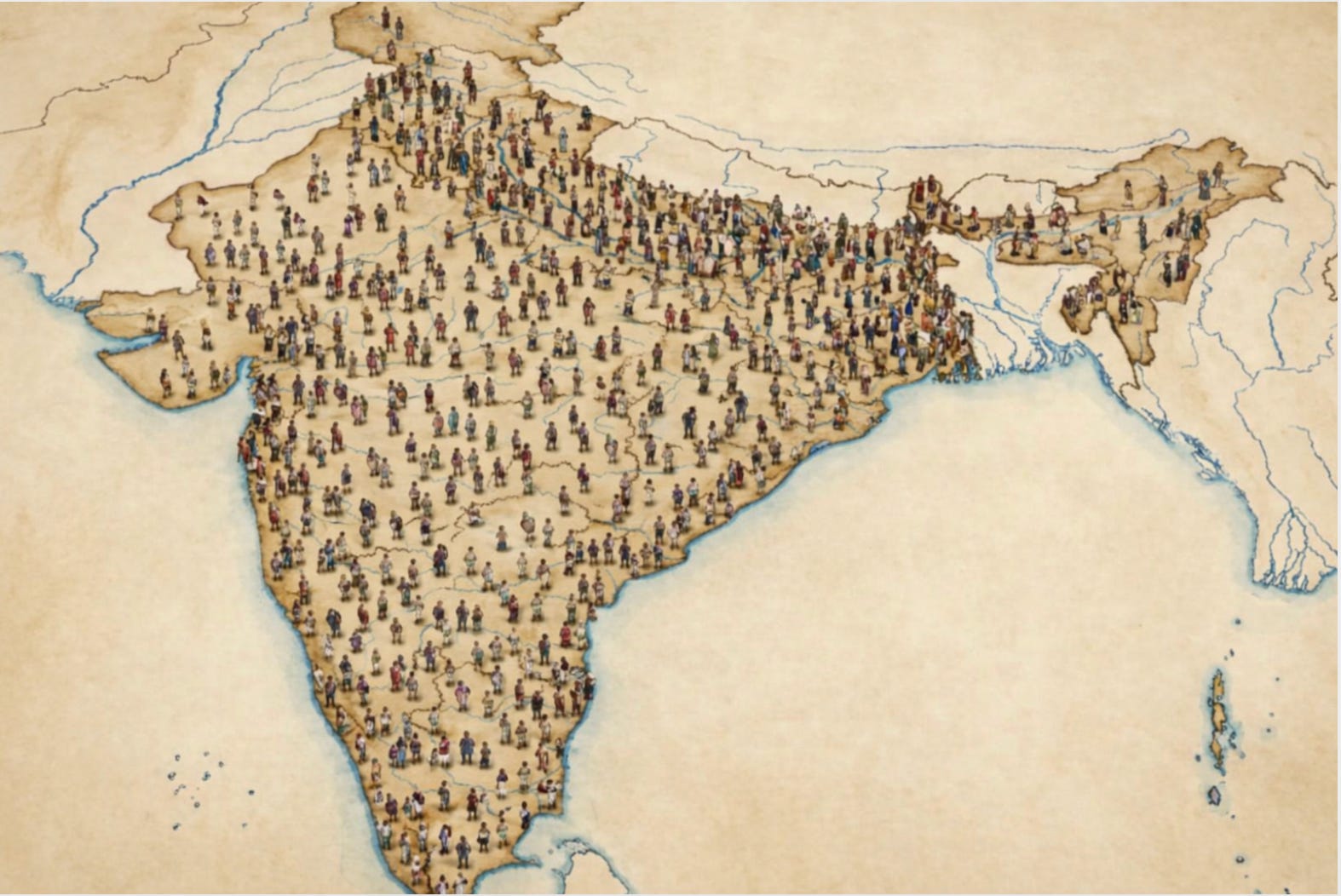
Each Indian election is the largest logistical exercise in human history. Yet last week the Indian government began what could be an even more complex task – a census to find the true figures of what is now believed to be the world’s most populous country. This is the first census conducted since 2011, when 1.21 billion people were counted.
The process will take a year to complete, and requires three million census workers to fan out across cities, towns, and villages, as well as trekking into isolated settlements high up in the Himalayas, as well as deserts, forests and remote islands. When the results are finally tallied, they will have major social, economic and political consequences, shaping both the domestic and foreign policy decisions the government takes over the next decades.
Central to this is the government’s plan to use the census data to expand the Lok Sabha – the lower house of parliament – from its current 543 seats to 816. In 2023, a new parliament building was completed for this purpose. This expansion will involve an entire redrawing of electoral boundaries to reflect up-to-date figures on population size and distribution. This will create a dramatic reshaping of what the Indian parliament looks like, and what regional interests are able to exercise power.
This reconfiguration is necessary as the current regional distribution of seats has been frozen using figures from the 1971 census. This has produced large undemocratic discrepancies between India’s states. For example, Tamil Nadu currently has 39 seats in the house with an estimated population of 85 million people, while Bihar has 40 seats with an estimated population of 135 million.
Over the past half a century the wealthier southern states have had far slower population growth – with fertility rates now below the replacement level. While the massive northern states of Uttar Pradesh and Bihar have expanded significantly. Uttar Pradesh currently has 80 seats in the Lok Sabha – 32 more than the next most in Maharashtra – but with an estimated population of 250 million it is still vastly under-represented.
The expansion of the Indian parliament is a necessity not just for fair democratic representation, but for MPs to effectively do their jobs. Currently the Lok Sabha has 107 seats less than the United Kingdom’s House of Commons, despite the UK having the population of the state of Gujarat. An Indian MP represents, on average, a constituency of around 2.5 million people, with some seats being far larger. Getting an audience with your local MP would be rather difficult.
Yet expanding and reorganising the parliament is highly political. With the governing Bharatiya Janata Party’s (BJP) primary supporter base being in the populous Hindi-speaking northern states, there has been arguments that an expansion would favour the party. However, the seats the BJP lost at the last election – forcing the party to form a coalition government – were mostly across the Hindi Belt. So the reality might be more complex.
The greater implications will be felt in the balance of power between the south and north of the country. The five southern states of Tamil Nadu, Kerala, Telangana, Andhra Pradesh and Karnataka are likely to lose their weight in the federal parliament, and given their distinct economic structures this could significantly impact India’s foreign policy decisions.
Cities like Chennai, Bengaluru, and Hyderabad have built thriving export industries in automobiles, electronics, pharmaceuticals, and software — sectors that rely on open trade and deep connections with global supply chains. Southern representatives in Parliament have long been the loudest voices for trade liberalisation and foreign investment. Losing relative power in the Lok Sabha may weaken their effective advocacy at a particularly delicate moment, when India has been positioning itself as a home for global manufacturers looking to be less reliant on China.
The economic contrast with the north is stark. Many northern states remain heavily reliant on smallholder agriculture, where farmers are acutely exposed to global price competition. The politicians who represent them tend to favour agricultural protection, higher tariffs on food imports, and a cautious – if not hostile – approach to trade liberalisation. The sticking point for countries seeking trade agreements with India has always been agriculture, but greater northern weight in the parliament could make this even stickier.
A northward shift in parliamentary influence would also tilt government attention towards domestic welfare transfers and rural development rather than urban-led outward-facing economic statecraft. India’s ability to credibly present itself to the world as a reliable node in global supply chains and an emerging great power with significant technical capabilities depends in part on sustaining a southern-led policy approach.
This means that the data collected by the census is not simply an exercise in determining how many people India has and where they are located. It will guide how the country organises its politics, distributes its resources, and engages with the world. Census data that reconstitutes India’s parliament will provide its northern states with the democratic representation they rightfully deserve, but it will also create stronger interests that may complicate the foreign policy calculations of New Delhi, and those of the governments and investors seeking to do business with it.