

In 1588, with the Spanish Armada off the coast of England threatening to overthrow Queen Elizabeth I and restore the country to Catholic rule, the philosopher Thomas Hobbes was born. He later claimed that “fear and I were born as twins”, and the emotion would become the dominant theme of his work. This work would set a baseline problem for the fields of political science and international relations, defining the worst-case logic for how human beings organise themselves and interact with one another.
What guided Hobbes was a belief that human life is shaped by insecurity, suspicion, and the constant anticipation of violence – a condition he describes as a “war of all against all.” His vision was bleak, yet from it he was able to construct a philosophy that he believed could encourage coexistence. When the threat of war against all went apocalyptic with the invention of nuclear weapons, military strategists found in Hobbes a ready-made blueprint – codifying the idea that peace depends not on trust, but on the fear of mutual annihilation.
By the 1980s, as Cold War tensions between the United States and the Soviet Union became more pronounced, the fear of nuclear war radiated throughout the culture. Alongside the daily news, there were the eerie public safety films, anti-nuclear protest movements that filled city squares, and books and cinema that extrapolated this fear out into dire scenarios, all creating an ambient sense of unease.
While fear often works in film, it’s not usually a great theme for pop music. Pop’s primary charm often relies on emotionally appealing feelings like love or nostalgia. Alarm and discomfort don’t get toes tapping or provide emotional highs. Yet this cultural fear also found its way into pop. Frankie Goes To Hollywood’s Two Tribes, Depeche Mode’s Leave In Silence, and Ultravox’s Dancing With Tears In My Eyes all were written in response to nuclear anxiety. While Morrissey claimed, in his usual wry tone, that “If it’s not love, then it’s the bomb that will bring us together” – a very Hobbesian sentiment.
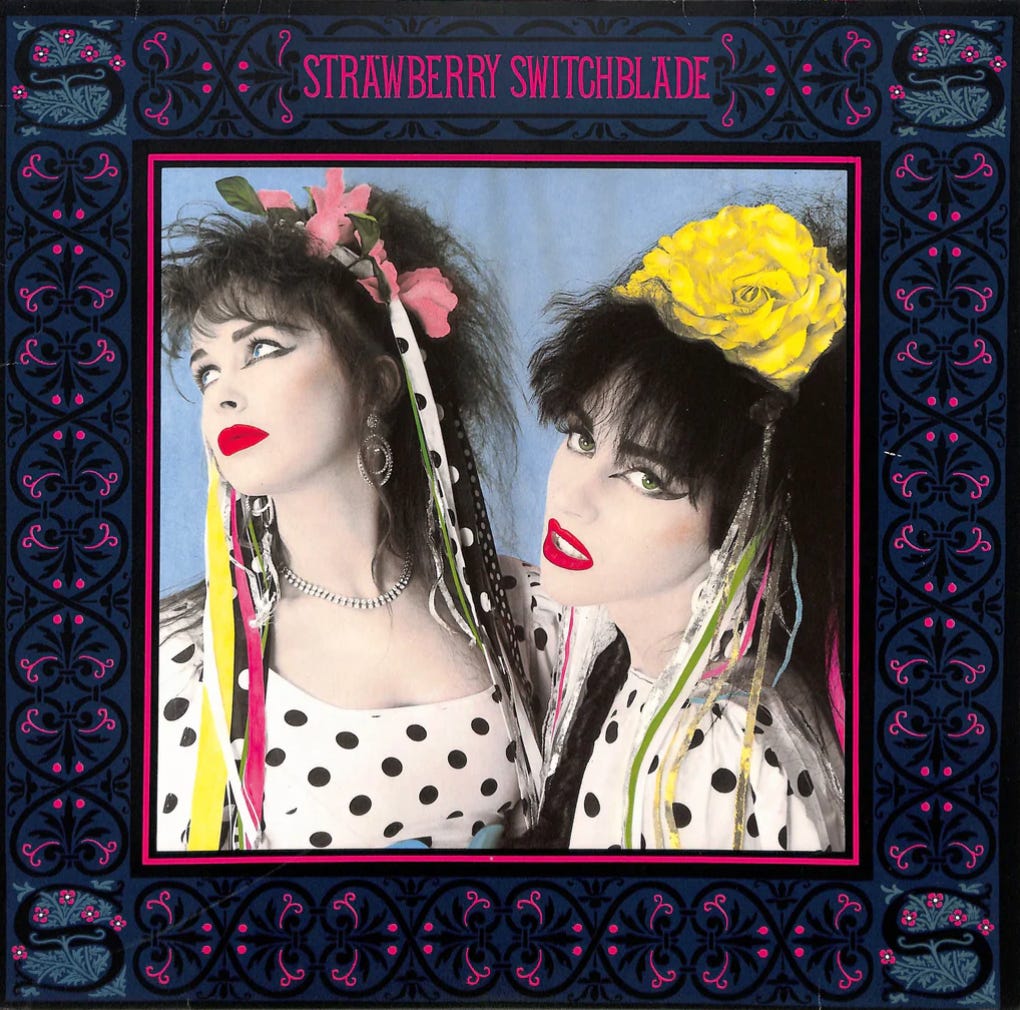
This nuclear dread ascended to the heights of the British charts through a pair of polka-dot clad Glaswegians called Strawberry Switchblade, with their single Since Yesterday. Packaged as an upbeat synth-pop song, lyrically the song is a quiet personal reckoning with impending destruction, as the dawning horror of understanding that the life you took for granted may be eviscerated. In this way, thoughts of yesterday become precious precisely because tomorrow has grown uncertain. Counterintuitively, it is dread that teaches us to appreciate the world, as with it comes the comprehension of what we may lose.
This is bleak, confronting stuff. Nuclear dread became a distinct fear as it was something you couldn’t run from or resolve personally. While other fears may be circumstantial, a nuclear war was omnipresent. Instead of being human scale, nuclear fear presented itself on a scale so disproportionate and all-inclusive that the usual instruments of survival were useless, or absurd. This was the fear of knowing that human annihilation was always technically possible, and always somewhere on someone’s desk.
Here there was a reliance on the responsibility of very few individuals operating under intense political pressure. People whose jobs were to act on orders which had unimaginable consequences. What made this more frightening was that fear doesn’t behave in a tidy manner under pressure. The theories of nuclear deterrence, the supposed restraints of Mutually Assured Destruction, didn’t seem strong enough.
The people tasked with monitoring, or orchestrating, the end of the world were subject to the full range of ordinary human weaknesses — fatigue, groupthink, confirmation bias, personal insecurities and the eagerness to please superiors. As well as a lack of vigilance from years of monitoring something that hasn’t happened. Stanislav Petrov, the Soviet officer who in 1983 correctly judged an incoming missile alert to be a false alarm, is celebrated as a hero, but he actually represents something more unsettling: a reminder that the entire architecture of nuclear weaponry rested on one man’s gut feeling working with systems that could create false information.
And as we sit here alone, looking for a reason to go on. It’s so clear that all we have now are our thoughts of yesterday
Strawberry Switchblade were working with the existential loneliness of such an environment. Where the future offers such devastation, that whatever existed yesterday was undeniably preferable. The invention of nuclear weapons, intensified by the ideological conflict of the Cold War, established more than the ability to destroy the world multiple times over; it informed us that Hobbes’s worst-case logic was our unavoidable permanent condition.
If Since Yesterday represented a political and globe fear, then Trees and Flowers was a far more personalised form of fear. Perhaps an even more devastating song, it maps the interior world of agoraphobia, where there is overwhelming reluctance to be in public spaces, driven by the sense that the world beyond familiar boundaries produces a crippling anxiety.
Stylistically, Trees and Flowers dispenses with the synths and is centred instead on guitar and piano. Yet it is the use of oboe that is its key feature. An instrument not often used in pop, there is a clear inspiration taken from Art Garfunkel’s Bright Eyes, but even one of pop’s saddest hits is outshone by the gorgeous, meandering and melancholic oboe melody on Trees and Flowers.
Such melancholy is the byproduct of agoraphobia’s fears. Sadness weaves its way through a life that can see normalcy outside but cannot participate. What others perceive as ordinary becomes an intense threat, one that compounds anxiety with any attempt to engage with the world as it is.
For I hate the trees and I hate the flowers, and I hate the buildings and the way they tower over me.
Agoraphobia is frequently misunderstood as a fear of public spaces, but more precisely it is a fear of the self within these spaces. It is an intense vulnerability of existing in a world without guarantees. A controlled and well-defined space like a home has known boundaries where there can be greater certainty of events. Beyond those boundaries certainty fades. Agoraphobia strips away the faith in our own actions that most of us carry unconsciously.
Søren Kierkegaard understood dread as the inevitable companion of freedom. Anxiety arises because our lives are not predetermined, because each action we take has a degree of uncertainty. For an agoraphobic, this is not an abstract philosophical proposition but a lived, physical reality. Their dread is not over something specific, but is the defining feature of existence.
As he recognised by claiming fear was his twin, Hobbes himself was not a detached analyst of the emotion, but a man who experienced it as a lifelong companion. His political philosophy was an elaborate intellectual attempt to master the personal feelings he could never escape. For Hobbes, to be human is to be perpetually aware of vulnerability, to live in the shadow of what might be done to us in the absence of structure and safety.
What agoraphobia and nuclear dread share, beneath their difference in scale, is the same confrontation with vulnerability. Hobbes understood that humans do not simply fear specific threats, what they fear is unreliability. What Since Yesterday and Trees and Flowers together reveal is this connection between the personal and geopolitical. That trust and confidence are our most valuable currencies, and yet also our most precarious.