

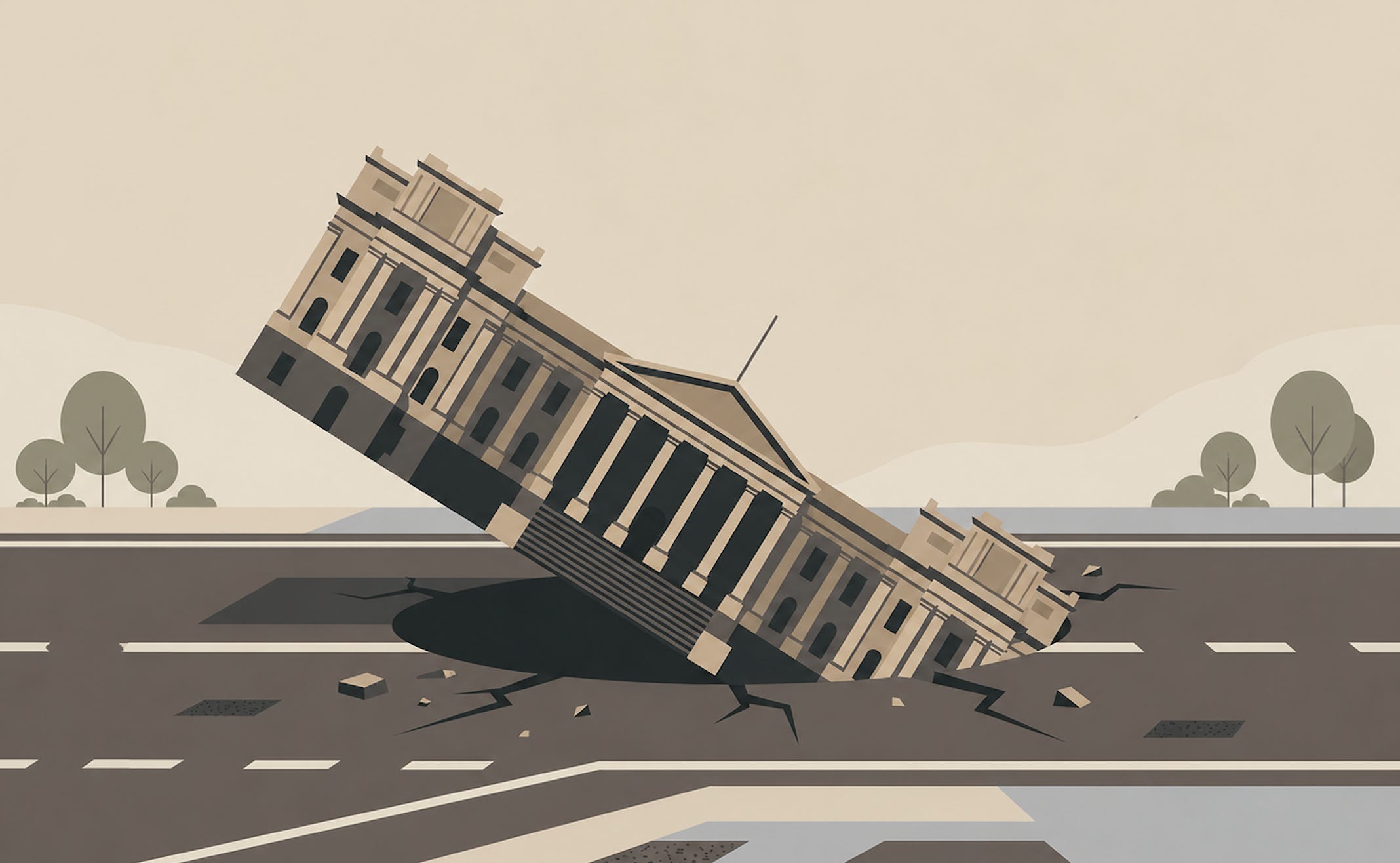
Last week I was having a cup of tea with a friend from India and she was telling me about an article she had recently read on rural Victoria. Interviewed for the article was a farmer who was complaining that the number of potholes on the state’s roads are making transportation of goods difficult, alongside a series of other fundamental operational difficulties.
She observed that the complaints of the interview subject could have been the complaints of a farmer in rural Maharashtra, and that this was odd given the vast development differences between Victoria and Maharashtra.
This article was not a single isolated comment. Potholes in Victoria have become a recognisable major problem.
Potholes may not seem like one of the grand problems currently facing humanity, and often complaints about them are dismissed as “boomerposting” or minor inconveniences not worthy of serious political discussion. But as my friend identified, the pothole is symbolic of “getting the basics right”. Australia is a fabulously wealthy country, and one of the clearest measures of a developed society is whether it can reliably deliver the fundamentals. So why isn’t it?
My theory is that a country’s wealth and its development indicators not only breed complacency, but they also skew priorities.
Within a ten minute walk from my flat there is a train line and four tram routes. I happened to buy a car last year, but prior to that I lived comfortably without one for a decade. Yet I still rarely use the car simply because I don’t need to (and because I’m a public transport enthusiast). In cities like Melbourne and Sydney if you have quick and easy access to a variety of public transport options this is a sign of your immense privilege.
I firmly believe that everyone should have the luxury of the amount of public transport options available to me, but obviously not everyone does. But, more importantly, the kinds of people who do have such a luxury are also the people who are responsible for “getting the basics right”. Arseholes like me – that is, the political, bureaucratic and knowledge classes – don’t think about potholes because we’re on the tram instead. Without direct daily experience, the state of the roads is simply not at the centre of the government’s thinking.
Yet the issue runs deeper than decision-makers simply lacking daily exposure to the state’s roads. The priorities of the highly educated classes are shifting government away from what it should be doing at a more fundamental level. There are, of course, bureaucrats whose job is to identify and plan maintenance work. But the decisions about what gets prioritised, funded and staffed rest elsewhere, within a system that now has a different set of instincts.
One of the grand trends over the past few decades has been the significant increase in the number of people with university degrees. In the 1980s around 10% of Australians aged 25-34 held a higher education degree. Now, close to 50% of this age bracket do. Similar wealthy countries have similar figures.
Education is good, and no one should be suspicious of it in principle. But the rise in widespread higher education has created a shift in the social structure of these societies and one that has knock-on effects that we may not realise are significant.
The first is that the state has felt the need to absorb some of this larger cohort of educated professionals. This has expanded the state into areas where, arguably, a liberal state should be more hands-off. This is particularly evident with social issues that should properly sit within civil society, yet are increasingly claimed as matters of state responsibility, as social science graduates move into the bureaucracy and bring with them a presumption that such issues warrant state promotion and priority.
Alongside this, in its absorption of this educated cohort, there is a hiring process that skews how the state thinks. With far more people competing for jobs in the bureaucracy or as political advisors, how people differentiate themselves becomes key, and this leads people to distinguish themselves with more innovative ideas. The result is that the credentialed class competes for bureaucratic and political positions on the basis of who can generate the most compelling case for expansion and reform, not who can run existing services well.
This also converges with incentives of progressive politics, which is influential within the bureaucratic class. Progressive politics rewards the advocacy of more radical social ideas, and has the incessant need to prove that one holds the correct opinions. Advocating fixing potholes for farmers is not going to generate status within progressive circles – it isn’t radical, it isn’t the great cause du jour, and it does nothing to demonstrate ideological commitment.
All of this develops a culture within the state that devalues the general maintenance and good governance that is essential for our modern societies. The boring, repetitive, attention to detail that keeps a society functioning earns no reward – so “getting the basics right” becomes an afterthought as institutions instead focus on what are considered bigger, more status-gaining, issues. This creates a certain irony, as the class of people selected and promoted for being clever has built a system that fails at the thing that we expect from educated people – competence.
This sits at the heart of the current challenges to liberal democracy throughout the West. Liberal democratic systems have historically earned their consent through efficient and effective service delivery. Governance that is focused on the practical, everyday, aspects of people’s lives, rather than grand ideological visions or attempts at soulcraft. This unglamorous competence was a critical feature of the postwar stability that is now breaking down.
When this delivery starts to erode, so does this consent. This occurs not through any single big failure, but through an accumulation of little things that no longer seem to work well. People generally don’t lose faith in institutions over ideas, they lose faith via their daily experiences. And potholes are a daily experience of decay.
This creates the fertile soil for populist political movements that channel people’s practical frustrations into a broader narrative of betrayal and blame. Movements that generate a sense that the whole system, not just the roads, has stopped working for them.
This is what makes the neglect of basic maintenance dangerous. When the political and bureaucratic classes come to believe that the basics are beneath them, what they are really believing is that the experiences of the broader public are beneath them. It’s an enormous sign of disrespect.
It is also an erosion of the bargain that is made between the governing and the governed – that in exchange for well-paying and secure jobs, the systems of governance actually work well to everyone’s mutual benefit. This bargain is what farmers in Maharashtra still hope for, and it is what farmers in Victoria are now losing.
'Pot holes' also represent a broader meme or narrative used by the fossil fueled right in regions.
Pot holes have been a fact of life for anyone in regions, plus more unsealed roads in the past.
However, see UK far right Restore has been highlighting 'pot holes' as a symptom of bad governance (by centrist councils) and to attract male motor heads with a simplistic promise of fixing the roads.
Further, eg a northern Victoria council (CoC & RE agents), had water fountains disappear from main (buy plastic bottles), along with trees (for more parking), pressure to cut community bus services (while more seniors) etc. while those who drive cars may claim no one uses VLine regional to Melbourne (in fact often booked out.... by seniors).
Recently with a friend who was driving inner west Melbourne (suffers too much heavy truck traffic) claimed that pot holes were being caused by EVs......
In South Africa they say: 'We used to drive on the left of the road. Now we drive on what's left of the road.' Good slogan for Victoria, too.