

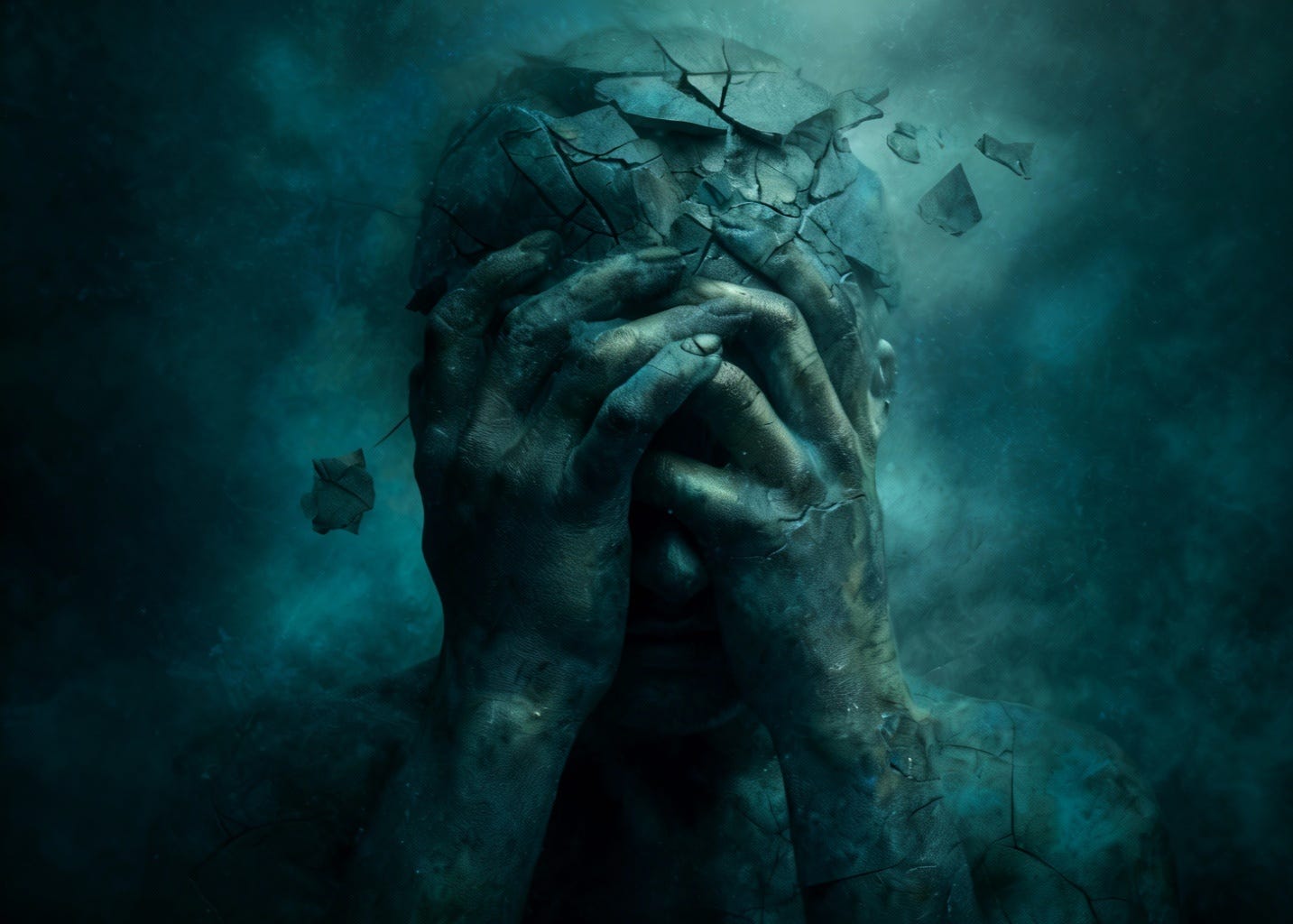
We are all so profoundly insecure. This is the pervasive sentiment that drives our current political and social movements. The chaotic emotions of MAGA, the obsession with gender – which includes masculinist clowns like Andrew Tate, the way we’ve siloed our media into informational safe spaces, and our attempts to sterilise the past as its realities don’t meet modern standards. It’s in our obsession with political labels, partisan teams, and social identities. We’ve become incredibly uncomfortable with being human, and seemingly incapable of being confident individuals.
These various manifestations of our insecurity have developed from the emotional stress of the pace of change. The economic and social revolutions of the past century, and especially the past 30 years, have unmoored us as people. Despite our ingenuity as a species, our monkey brains are still ill-equipped to handle such rapidly shifting environments. Leaving us anxious and with a heightened threat perception.
However, this anxiety has been compounded by a change in the way we discuss our world. Due to the brutal atrocities of the 20th Century, in its concluding decades we shifted how we viewed history. Rather than seeing history through the lens of the victor, we switched to prioritise the victim. For our own humanity this was essential, but it came with an unintended consequence. Social power now lies with your ability to present yourself as a victim of history.
Rather than seek to overcome our insecurity, we instead celebrate it. Victimology teaches us that insecurity and marginalisation is what we should be striving for. This may commonly be identified in postmodern progressive politics but is also clearly present in figures like Donald Trump who – despite being the president of the United States – is responsible for nothing, and always the victim of others. His return to the White House can be understood as the push and pull of a collective sense of victimhood and the waves of social resentment that has flowed from it.
Our insecurity is driving our retreat into what Søren Kierkegaard recognised as the danger of crowds. A phenomenon that aggravates itself. The more insecure we feel, the greater the need to submit ourselves into various identity and political groups. But the more we do so, the more we feel threatened by other people doing likewise. It is in this environment – where the confident individual is weakened – that “untruth” and authoritarianism thrives.
Insecurity craves political figures to submit to, so provides fertile ground for the reemergence of personality cults – from Trump to Jeremy Corbyn. These are figures who are deemed to be holders of the singular truth and pureness of spirit. Whose word is always gold, and who therefore all authority can safely be delegated to. Figures who can relieve you of the need to think for yourself.
While there has always been a desire within humanity to outsource our brains to others, our current collective insecurity has been inflamed by the peculiar form of narcissism borne from the online age. A paradox that sees the self as the most important entity, but this self must conform to group traits. This has created the cult of identity, which sees personal and group victimhood as a path to political and institutional power.
Alongside its designs on power, identity politics’ belief is that it is striving for authenticity. Yet in reality, it is the opposite. Instead of being authentic, identity is affected and laboured. It is the performance of personality, fabricated for the attention economy and then exported out into the polity.
Genuine authenticity doesn’t constantly think about itself. It is simply the confidence to be. But the confident individual doesn’t exist within a vacuum, there is no authenticity without a recognition of humanity’s social context, with its duties and responsibilities to others. Identity, however, is often anti-social with its rejection of both broader humanity and local culture. It sees self-exertion as its priority.
While identity believes itself to be culture, it is distinct in critical ways. Genuine culture exists within habits, manners and traditions. It is the unconscious inheritance of people within a community. It has no need to advertise itself. It doesn’t require a loudspeaker, overt symbols, or to be continuously affirmed. While nations may have flags, they don’t necessarily need them. Flag-waving is often an expression of the nation as an identity, rather than a culture. The contrived performance of a nation, rather than the subconscious application of its customs.
Nations and communities of confidence and resilience can handle debate and disagreement. They can house a myriad of ideas within a framework of common practices and interests. By contrast, insecure nations and communities – and especially political teams – demand conformity. They see those who don’t fall in line as threats and become aggressive in their attempts to police behaviour.
As insecurity and identity have taken hold throughout the West, we have become people without qualities. To be resilient and adaptable garners us no attention and therefore has no social worth. Neither does having the character to live by integrity and responsibility. This degradation of character has revealed that political norms – and even constitutions – are easily dispensed with by the corrupt and deceitful.
This degradation of character is being exacerbated by the pathologising of the human condition. Where normal, everyday, feelings or behaviours are deemed to be symptoms of a mental disorder. To have a hobby now is to be autistic. To be organised and tidy is OCD, to be disorganised and messy is ADHD. These “mental illnesses” have also become an identity. Repackaged as being “neurodivergent” and included in one’s social media bio.
Pathologising is not only central to victimhood but driven by a desire to have an excuse. We are eschewing personal responsibility and asking others to permanently deem us to be incapable of any adult task. We no longer have the capabilities to navigate the world with confidence. We no longer expect this of ourselves.
Stripping away character and confidence has left us devoid of the public narratives required to encourage positive action in our daily lives and to strive for greatness. As the philosopher Susan Neiman has recognised, the shift in our view of history has not just encouraged victimhood, it has taken away the hero as a central actor in the stories we tell and as an exemplar of human behaviour.
The hero encouraged virtue. The hero’s appeal is different to the appeal of personality cults. His role was to simply be emblematic of positive ambition, demonstrating principled leadership and human excellence. To provide inspiration, not submission. The hero played an especially important role in directing the energy of young men towards positive outlets. Giving young men guidance and purpose, without which their energy can turn chaotic and dangerous.
The problem we face now is that the desire for heroism remains, but without any positive extraordinary efforts within both our history and modern stories this demand is being serviced by people with nefarious ambition, like Trump and Elon Musk. These grotesque men are being valorised because they’re the only men who seem to be demonstrating any ambition, and there is no prominent counter-model to encourage our better angels.
The influence of nefarious ambition is not only degrading our political institutions, but our social infrastructure as well – creating the extensive mistrust that compounds insecurity. The relationship between bullying and victimhood is obviously symbiotic. There are real, genuine, victims who are subject to the brutality of others. But bullies tend to see themselves as victims of social conditions that aren’t servicing their psychological needs. So, as we’ve centred victimhood in our stories, we’ve created fertile soil for bullies to roam.
This practice of victimhood therefore weakens our mutual cooperation. The lines between perceived threats and genuine threats become blurred, and everyone who may be different – whether it be skin colour, religion, or political views – becomes suspicious. The practice of victimhood hasn’t advanced empathy; it has done the very opposite. It has led us to retreat further into insular, insecure, and agitated groups.
As economic and social change are conjoined twins (with the former one foot ahead of the latter), our social institutions – like religion – that could have grounded us through our escalating innovation have also been swept aside. We now lack the forms of organisation that gave us a broad common purpose and thicker social relations.
Despite disputes between religions and denominations periodically turning sectarian and violent, the traditional religions at their best restrained us from descending inward into parochial niche groups, and especially inward into ourselves. They could provide a social binding agent, even in plural societies of multiple faiths.
In this way, their merit was less about the worship of God, and more about asking us to think about others, rather than ourselves. You would turn up to your church, synagogue or mosque and it gave you a genuine, in-person, community. And it – hopefully, depending on the sermon – left you with a series of outward-facing ideas that inspired duty and virtue in your daily behaviour. The traditional religions could be character-building machines.
Although commitment to these religions has waned, our desire for mysticism hasn’t abated. It has instead found new outlets that are far less socially constructive. Our new mystical beliefs like wellness, genderism, and the sovereign citizen movement, are entirely self-centred. They see their primary obligation as being to oneself, and any communal duties and responsibilities are seen as discriminatory threats.
Such self-centred movements have capitalised on the privatisation of “the good”. A shift in collective thinking where maximising personal advantage is deemed life’s primary objective. This has created a social form of neoliberalism – where homo economicus has been joined by homo identicus. While the objective of homo economicus has been to simply maximise income as a worker and gains as consumer, homo identicus seeks to maximise social power by placing demands on societies to be recognised as requiring privileges due to group and/or victim status.
These demands of homo identicus are therefore in direct challenge to the rule of law. They seek to create law not on mutually beneficial principles where everyone is equal before the law, but instead where those of perceived victimhood status are favoured by the law. This has further incentivised victimhood as a path not just to social power, but state power. An incentive that movements like MAGA have also understood as an opportunity to subvert the rule of law through their own narratives of victimhood.
Our pervasive insecurity is now eating away at our institutional and political structures. It is eating away at our pluralism and social cooperation. It is eating away at our ability to derive genuine meaning from our lives, and it is eating away at our ability to be resilient, character-bound, confident individuals. The latter of which is our bulwark against authoritarianism.
Shifting our view of history from the victor to the victim hasn’t led us to learn from the brutal mistakes of the 20th Century. It has instead created the conditions for the brutes to return.
There's a better analysis of insecurity by Astra Taylor.