

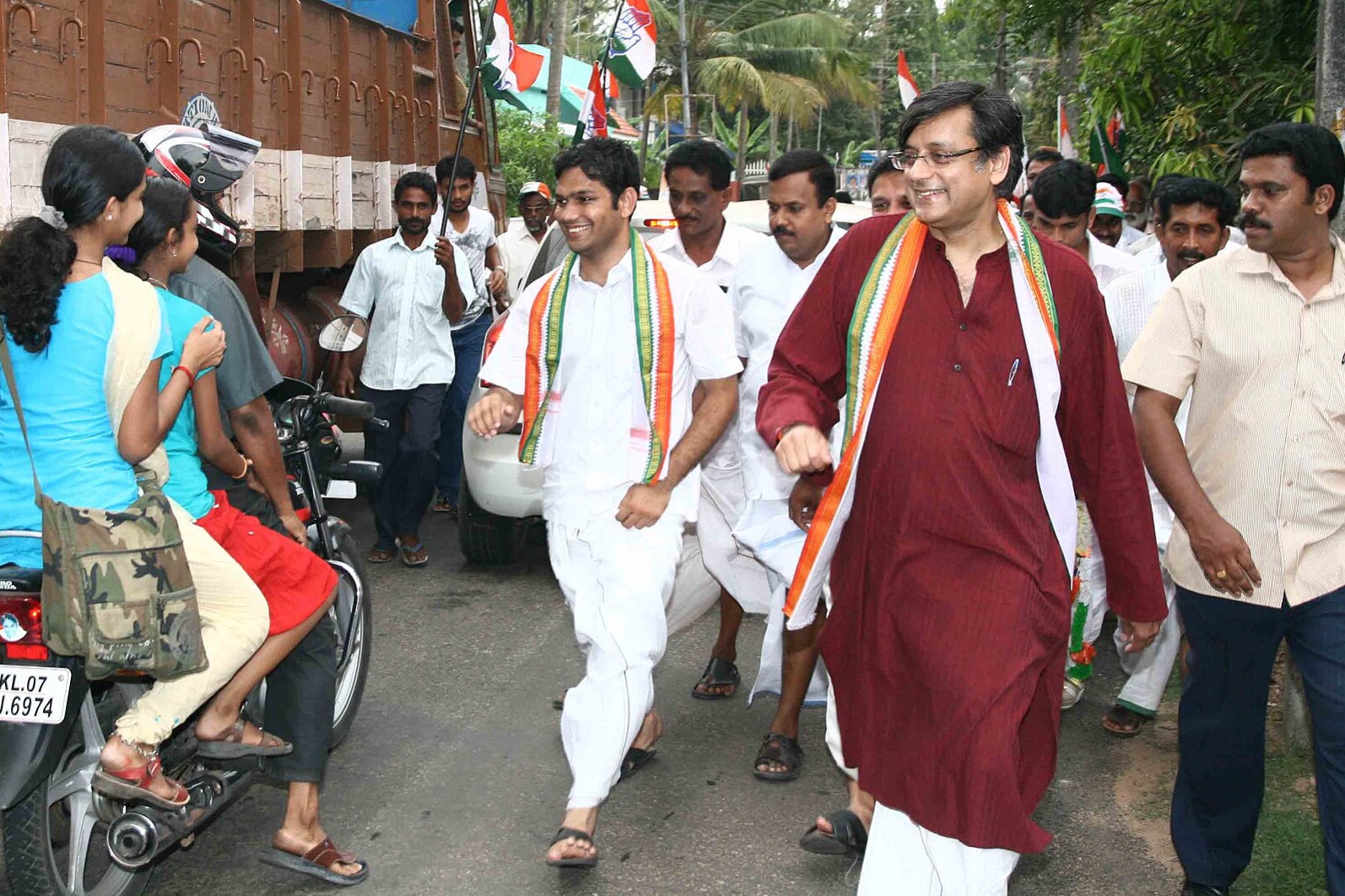

Shashi Tharoor can often seem like relic from a previous era of Indian politics. A man of refined manners and affectations, a charming eloquence and a born raconteur. He evokes the cohort of Indian politicians who drove the country’s independence movement – educated in the West’s great cathedrals of learning, and entirely comfortable in their halls of power and cultural milieu. India’s first prime minister post-independence – Jawaharal Nehru – joked that he was “the last English ruler of India”. Throughout his career, Tharoor has been a keen Nehruvian – in both style and substance.
At 22, Tharoor was the then youngest person to receive a PhD from the Fletcher School of Law and Diplomacy at Tufts University, having already obtained two Masters degrees. He immediately pivoted this into a career at the United Nations, first in the High Commission for Refugees (UNHCR) and then in the Peacekeeping Operations Department. He would eventually seek the job of UN Secretary General, finishing second of seven candidates in 2006, just behind Ban Ki-moon.
From here Tharoor turned his attention to Indian domestic politics. Winning the federal seat of Thiruvananthapuram in Kerala representing the Congress Party in 2009. A seat he has held ever since. Upon his election, he was made Minister of State for External Affairs – which is an assistant minister position in India – in the second government of Manmohan Singh, and given the role of advancing relations with African countries, where his fluency in French served the job well.
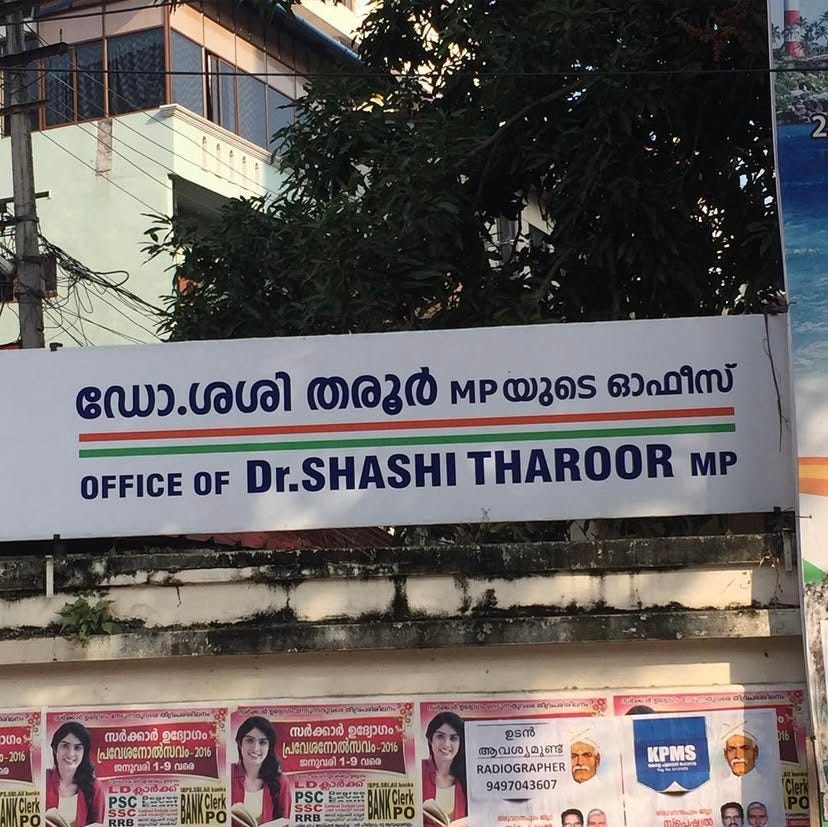
I happened to wander by his constituency office when I was in Kerala in 2016. Which is my kind of sight-seeing.
Despite being an MP – and an assistant minister for his first five years in parliament –somehow Tharoor has managed to also be a prolific writer. Barely a year has passed over the last decade and a half without him publishing a book. He is comfortable writing on history, foreign affairs, domestic politics, religion, as well as biographies of major Indian figures. He has published 25 books in total.
Yet these are not just works of non-fiction, as there are four novels among them. Most notably the slyly titled The Great Indian Novel, which is built on an ingenious framework that takes the Mahabharata – the epic poem of Hindu mythology – and resets its themes within the Indian independence movement and first decades of independence. With the major figures of Indian politics at the time taking on the traits of the characters from the Mahabharata.
Tharoor is also a compelling and persuasive speaker. He loves the thrust and parry of an argument, and can make one better than most. Even if his adherence to evidence can sometimes wane, he has honed a style of speaking that draws in an audience and leaves them fascinated by every word.
This all marks Tharoor as one of the world’s most disgusting overachievers. One of these people who has the confidence to turn his attention to whatever he likes, and excel at doing so. Making us all look pathetic by comparison.
Yet for all his achievements, the one job Tharoor actually wants – prime minister of India –is seemingly beyond his grasp. There are two big structural reasons for this.
The first is India’s current domestic political conditions. Although when Tharoor entered parliament, the Congress Party were strong enough to be able to lead a coalition government, this dramatically shifted with the rise of Narendra Modi as the leader of the Bharatiya Janata Party (BJP) and the majorities it was able to achieve at the 2014 and 2019 elections – and although short of a majority in 2024, still comfortably the largest party in the Lok Sabha (lower house). Despite improvements in its position at the last election, Congress is still a shell of its former dominant self.
The other structural reason thwarting Tharoor’s ambitions is the internal politics of the Congress Party. The party is the family business of the Gandhi family, and maintaining control of the party is their primary purpose.
Although Nehru himself would have likely found this situation unacceptable, his descendants have made the party their own following his death. His daughter Indira Gandhi was prime minster from 1966-1977, and again from 1980 until her assassination in 1984, her son Rajiv became PM following his mother’s death until 1989 (and was assassinated himself in 1991), and Rajiv’s wife, Sonia, became party leader in 1998.
Although Sonia would lead the party to victory in 2004, the BJP’s hostility towards her Italian heritage led her to step aside for Manmohan Singh to become prime minister. Since the defeat of the Singh government in 2014, Rajiv and Sonia’s son Rahul has either been the official or effective co-leader of the party with his mother – and he is currently serving as leader of the opposition in the parliament. Although, on paper at least, both he and Sonia have relinquished the presidency of the party.
This is the wall Tharoor found himself up against when the Congress Party held an internal election for the party presidency in 2022. The Gandhi family at the time felt that the optics of their party control was detrimental to its electoral fortunes, and decided to (formally, at least) relinquish the presidency. Tharoor sensed his opportunity to gain greater power within the party and use the position to elevate himself as the man who could effectively challenge and defeat Modi.
But, of course, the Gandhis would have seen Tharoor’s personal popular reach and independent ideas as a threat to their own power. And so a loyalist was found in Mallikarjun Kharge, and party members were strong-armed into throwing their support behind him. Kharge won 84% of the vote to Tharoor’s 11%.
Initially Tharoor accepted this with grace. But recently both his disgruntlement and ambition has begun to bubble to the surface. He’s been engaged in considerable, what we call in Australia, “freelancing” – when an MP starts pursuing ideas and positions outside of their party platform. In an attempt to build his power outside of the party.
This has begun by endorsing a number of foreign policy initiatives by the BJP-led government – including Operation Sindoor, which launched missile strikes on Pakistan-based militant groups Jaish-e-Mohammed and Lashkar-e-Taiba following the terrorist attacks in Kashmir. This led to Tharoor being sent by the government on a diplomatic mission to explain India’s actions to the world. With this mission probably being less about Tharoor’s eloquence on foreign media outlets, and more about seeking to wedge Congress on national security issues.
Tharoor has also raised the ire of his party by praising L.K Advani – the former BJP politician who played a central role in the destruction of the Babri Masjid by a Hindu nationalist mob in 1992. Given that the destruction of the mosque and the subsequent building of a Hindu temple on its site is the central story in the BJP’s rise to power, one could see such praise for Advani as the path to making Tharoor acceptable to the BJP. Maybe not as an MP crossing the floor, but potentially for another official role like an ambassador, or even – at a stretch – India’s ceremonial presidency.
While Tharoor’s outreach to the BJP is a mild irritant to Congress, his direct attacks on his party have been infuriating.
Tharoor has recently written critically of “The Emergency” declared by Indira Gandhi from 1975-1977 – where elections were suspended, media and civil liberties were restricted and Gandhi’s political opponents were imprisoned. While Gandhi’s other son, Sanjay, oversaw a mass campaign of vasectomies. The Emergency was unquestionably a dark period of Indian history, but raising it is the third rail of internal Congress Party politics. No MP wanting to have a future in the party would do so.
If this wasn’t a big enough poke in the eye to the Gandhi family, two weeks ago he wrote an article for Project Syndicate titled Indian Politics are a Family Business. Tharoor’s article stated that “dynastic politics pose a grave threat to Indian democracy.” He declared it “problematic when candidates’ main qualification is their surname.” And that members of political families “are often particularly ill-equipped to respond effectively to their constituents’ needs.” And, in a clear dismissal of his own lost election for the party presidency, claimed there was a need for “meaningful internal party elections.”
All this was a hefty grenade hurled over the fence of 10 Janpath – the Gandhi family residence in New Delhi. It is likely that the relationship between Tharoor and the family is now permanently broken.
Yet it has been another recent endeavour by Tharoor that will have raised some eyebrows outside of India. At the start of September, Tharoor began a series called Imperial Receipts – based on his book Inglorious Empire – for the Russian propaganda network, RT. Which was formerly known as Russia Today, but retreated into just RT to disguise its origins in the hope of expanding its influence.
Tharoor is, of course, not wrong to expose the nature of Britain’s colonial project in India. Yet doing so via an outlet of blatant Russian propaganda reeks of a certain cynicism. Not to mention hypocrisy, given Russia’s own brutal imperialism. Both historical and present.
The purpose for RT with such a program is to arouse anti-Western sentiments within India (and beyond), and have these be converted into a suspicion towards the West’s support for Ukraine. To establish a narrative that that the West aren’t just historical colonial brutes, but modern-day ones too. To create the informational conditions that would lead people to believe Russian narratives that it is the actual victim in its invasion of Ukraine.
As India is now courted by the West as an essential partner to balance the power of the People’s Republic of China, and hopefully play a role in countering Russian aggression, Moscow is using programs like this – and people like Tharoor – to try and prevent more cooperative and friendly relations between India and the West.
Tharoor is smart enough to know that the Russians are using him in this way, and smart enough to know Russia’s narrative that he is helping advance is pure bullshit. But his cynical ambition and desperate need for the spotlight is clouding his better judgement. It is unfortunately the case with men like Tharoor that the one capability they lack is the most important one – humility.
Interesting. My only exposure to India was comprised of several trips working for the International Justice Mission. It's a tough place... a beautiful place in many ways, but a very layered and complex system of corruption.