

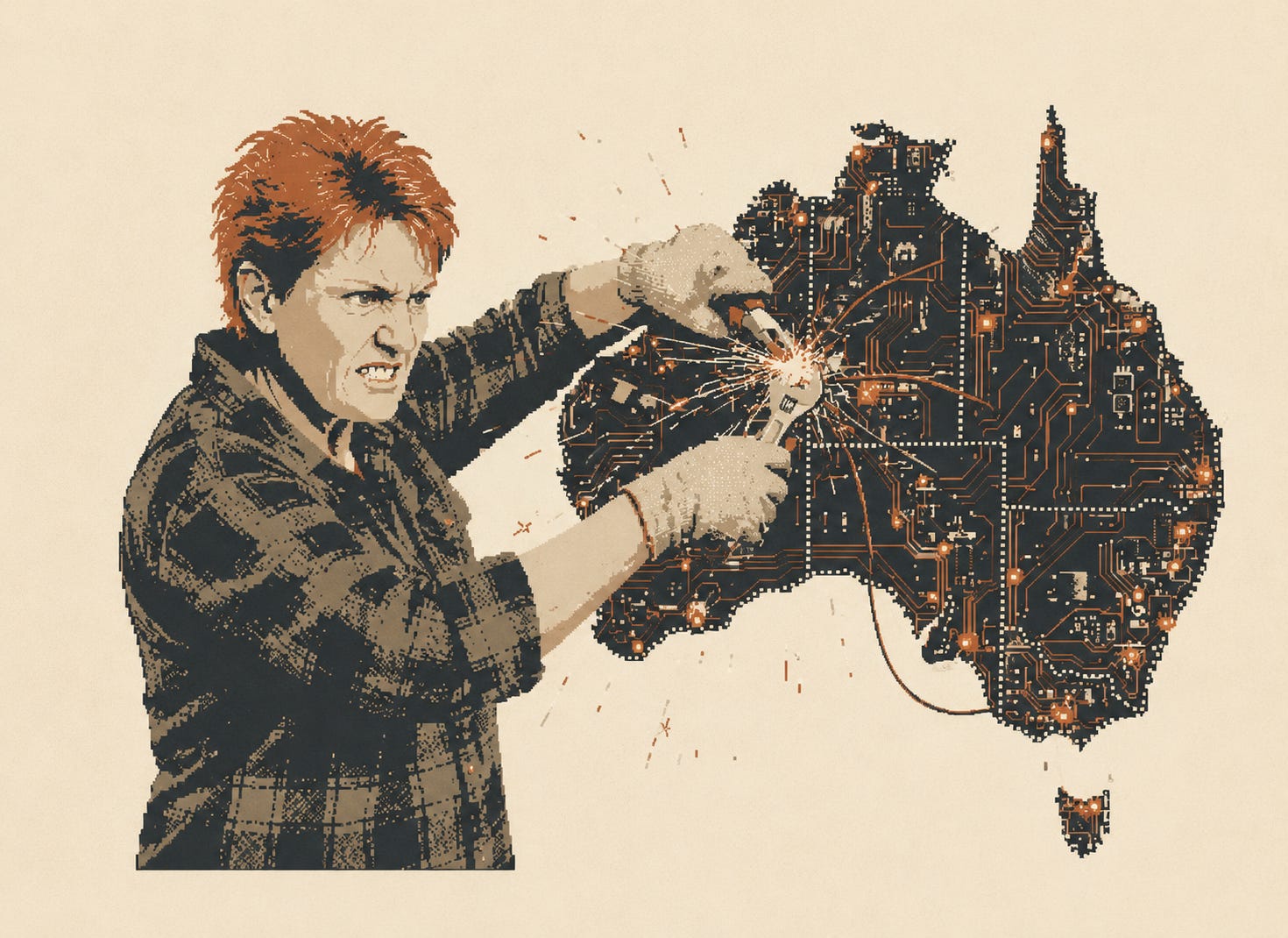
Australians had smugly prided themselves on their aversion to populist politics. We thought we were immune to reactionary revolts taking place in America and Europe. We thought our system of compulsory and preferential voting provided us with a bulwark against those hostile to liberal democracy – forcing politics to be about sensible and rational approaches to public policy. Not grievance and ideological fervour.
I had also previously made the case that Australia was a conservative society – in the dispositional sense, not the political sense – and that this made the attraction to chaotic political movements weak. Nothing could be more suspicious to an Australian than someone who rocks the boat.
Yet this looks to be changing. Or, as I will elaborate later, how chaos is understood and responded to may be distinct from our rational assumptions. An election last month in the state of South Australia saw a surge in support for the One Nation party. Sending a shockwave through Australian politics.
For some background for non-Australian readers:
One Nation has been the political vehicle for Pauline Hanson. The party’s official name is actually Pauline Hanson’s One Nation. Hanson was first elected to the federal House of Representatives in 1996 in unique circumstances. She was selected to run in the seat of Oxley in Queensland by the Liberal Party, however after some disparaging comments she made about Indigenous Australians she was disendorsed by the party.
Yet, it was too late to remove this affiliation from the ballot paper. She won the seat, but the Liberal Party leader at the time, John Howard, did not allow her to sit with the party. She initially sat as an independent. In her maiden speech to parliament she claimed that the country was being “swamped by Asians”. Which set the tone for her initial time as an MP – race-baiting as a political platform.
In 1997 she formed One Nation and by the 1998 Queensland state election the party looked to have momentum. The party won 11 seats on 22.6% of the vote. Yet an early federal election later that year saw Hanson lose her seat, and then the party in Queensland began to crumble. By the time of the next election all 11 of them had left the party, choosing to sit as independents, form other parties, or not stand again.
This seemed to be the end of Hanson, and she soon faded from public view. But as is the case with politics in the modern world, things were about to get weird. She was invited by Channel 7 to be a contestant on “Dancing with the Stars” rehabilitating her in the public mind, and by 2016 she was back in the parliament, this time in the Senate. Since then the focus of her rage has been against Muslims, rather than Asians.
Given voting in the Senate in Australia is conducted by proportional representation – with each state being a single constituency – it is much easier to be elected to it than to the House of Representatives. Over the past decade the party has won several seats in the Senate with around 4% to 7% of the vote, depending on the state. But again, keeping these people inside the party has been difficult. Until recently, it has only been Malcolm Roberts – a man who has never heard a deranged conspiracy that he wasn’t enthusiastically convinced by – who has stuck by Hanson.
In final weeks of last year there was a noticeable shift in polling numbers towards One Nation. This led to Hanson pulling off a coup, convincing Barnaby Joyce, the former leader of the National Party – and former deputy prime minister – to defect to One Nation, giving the party a seat in the lower house. Even though Joyce himself is mad as a sack full of cut snakes, his defection gave the party greater credibility in the eyes of supporters of the National Party and the Liberal Party (these two parties exist in a permanent coalition with each other). Polling numbers continued to rise.
The first test of these numbers came at the South Australian state election last month. At the previous state election the party polled 2.6%, and given that the state is one of the most urbanised in the country, with over three quarters of the population living in the Adelaide metropolitan area, it was seen as not being fertile ground for the party.
Australian states function with the same Westminster-style parliamentary systems as the federal parliament, with each state divided into electorates by population. With an independent commission drawing these boundaries, not political parties like the United States. South Australia is the second smallest state by population, and so its House of Assembly has just 47 seats.
The polling numbers leading into the election turned out to be accurate, with the party able to gain 22.9% of the vote. However, due to this share of the vote lacking significant geographical concentration in many single member electorates this only translated to 4 seats. This meant it won one less seat than the Liberal Party, even though it secured 4% more overall votes state-wide.
Although seats are less important than votes here, as this lack of geographical concentration may be more of a problem when thinking about how to counter such political forces. A geographical concentration of votes would allow us to see the support for the party was within certain regions and demographics – and solutions could be devised to address this regional or demographic discontent. A more widespread vote means that discontent has permeated through multiple different regions and demographics. Discontent is in the water.
So what does this say about Australia and our current Age of Discontent throughout the West?
Maybe rather than us Australians being smug about our inability to be drawn in by such politics this is just a case of culture still coming to Australia by ship? We’re not superior after all, we’ve just taken a while to catch up.
What we are catching up to has been an overarching sense that the promise of liberal democracy – rising prosperity, political inclusion, and social stability – has felt hollow in the 21st century. Cynicism has intensified through seemingly purposeless wars in Iraq and Afghanistan, coupled with the Global Financial Crisis which exposed systemic inequalities, showing that markets and governments often protect elites while ordinary citizens bear the costs of economic shocks.
Broad trade liberalisation has created winners in urban, skilled sectors, but as manufacturing has been outsourced to countries like China, regional and outer suburban communities have lost sources of work which provided social structures, pride and dignity. This has been intensified by housing shortages that have burdened people with massive debt, while stagnant wages and inflation has compounded insecurity.
Governments, the media and other cultural institutions have foregrounded progressive identity politics that people see as elite predelictions, disconnected from both the economic priorities of the broader public, and how people have traditionally understood the world. Together all this has fuelled a deep distrust in the political establishment, creating dynamics that have eroded faith in liberal institutions, leaving citizens feeling abandoned by the very systems meant to protect their livelihoods and provide them with an investment and voice in a country’s affairs.
As I wrote in Nations Against States, there is also a strong disconnect between how the state understands how it secures the country and builds prosperity, and how people understand the nation as primarily a cultural entity. All of this creates fertile soil for parties like One Nation to harness grievance and offer simplistic and emotionally satisfying remedies to highly complex problems – with these remedies often based around blunt hatreds and aggressive finger pointing.
As we’ve seen from the rise of Donald Trump in the United States and other turbulent movements in Europe there is a political paradox in our current era – where people who claim to be “conservative” are attracted to a chaotic form of politics. Where people see pyromaniacs as firefighters.
This can seem irrational, but there may be some method to the madness.
Political movements like Trump, One Nation, Reform UK, Alternative für Deutschland and Rassemblement National can be understood as a form of “circuit-breaker” – a deliberate disruption of an existing political, institutional and constitutional order. These movements seek to overload the normal functioning of governance – entrenched political and cultural norms, bureaucratic routines, institutional guardrails. The logic is not just to try and govern differently, but to force a system-wide interruption that creates conditions for a new political and economic framework to emerge.
The economist Albert Hirschman described this as “Exit vs Voice”. In his model, citizens who are dissatisfied with a political system can either try to reform it (voice) or withdraw from participation (exit). There are many people throughout the West now who see the conventional channels for “voice” as futile. Instead they find themselves attracted to political actors who present themselves as the “exit” from the status quo – claiming they can break the system and create something new and better.
The current fracturing of Australian politics has produced a significant “voice” movement as well, via the Community Independents Project, which I wrote about in How To Reclaim Democracy. Interestingly, there is a by-election in the federal seat of Farrar on 9 May, and this looks to be setting up an Exit vs Voice contest between One Nation and the independent candidate – with the traditional large parties being sidelined.
The crisis of liberal democracy and the cognitive overload of the modern media environment has created fertile ground for the “exit” approach. In this context, circuit-breaker politics is seen by those attracted to it not as reckless, but as necessary, where only radical interruption can reset the system and produce meaningful outcomes for those who feel desperate within current conditions.
However, the circuit-breaker strategy carries grave risks. As we are seeing the United States. The consequences of tripping the existing system are unpredictable and highly volatile, and often this can create far worse conditions than those that the circuit-breaker sought to replace.
In the Australian context, the attraction of One Nation looks likely to simply create the conditions that will entrench Labor Party governments across the country. At the South Australian election Labor won 34 of the 47 seats due to One Nation’s surge weakening the Liberal Party. Such results will only aggravate grievance and conspiracy amongst those attracted to One Nation. The system may not overload, but if support holds at 20-25% it will instead create enough spikes that will damage the country’s political and social infrastructure.
Great analysis - thank you. Made me wonder about previous disruptive movements that grew from those without a voice (like the Labour Party in the UK of course). There's clearly a case to be made for disruption when the status quo has become so self-serving / moribund but it seems that these new forces are always on the right rather than on the left (I realise that the difference is often hard to spot nowadays). We live in worrying times!