

With its daily absurdities, we’ve become desensitised to how thoroughly weird the Trump administration is. Not only weird politically, but weird as human beings. Trump himself is a cognitively dysregulated acid-trip huckster, but he leads a team who are just as emotionally chaotic, resentful, drama-prone, aggressive, manipulative, vindictive, psychologically brittle, desperate for validation, comically defensive, and haunted by their own personal inadequacies. It is a constant rollercoaster of petty psychodrama, unfolding from within the command centre of the American state.
Yet the ascent of these people to power is representative of our era. We are living in an era of wholesale emotional insecurity and psychological fragility. This is exhibiting itself in a multitude of different ways, but it is arguably the status anxiety of the modern male and how it is spiralling up into the Trump administration where it is the most impactful.
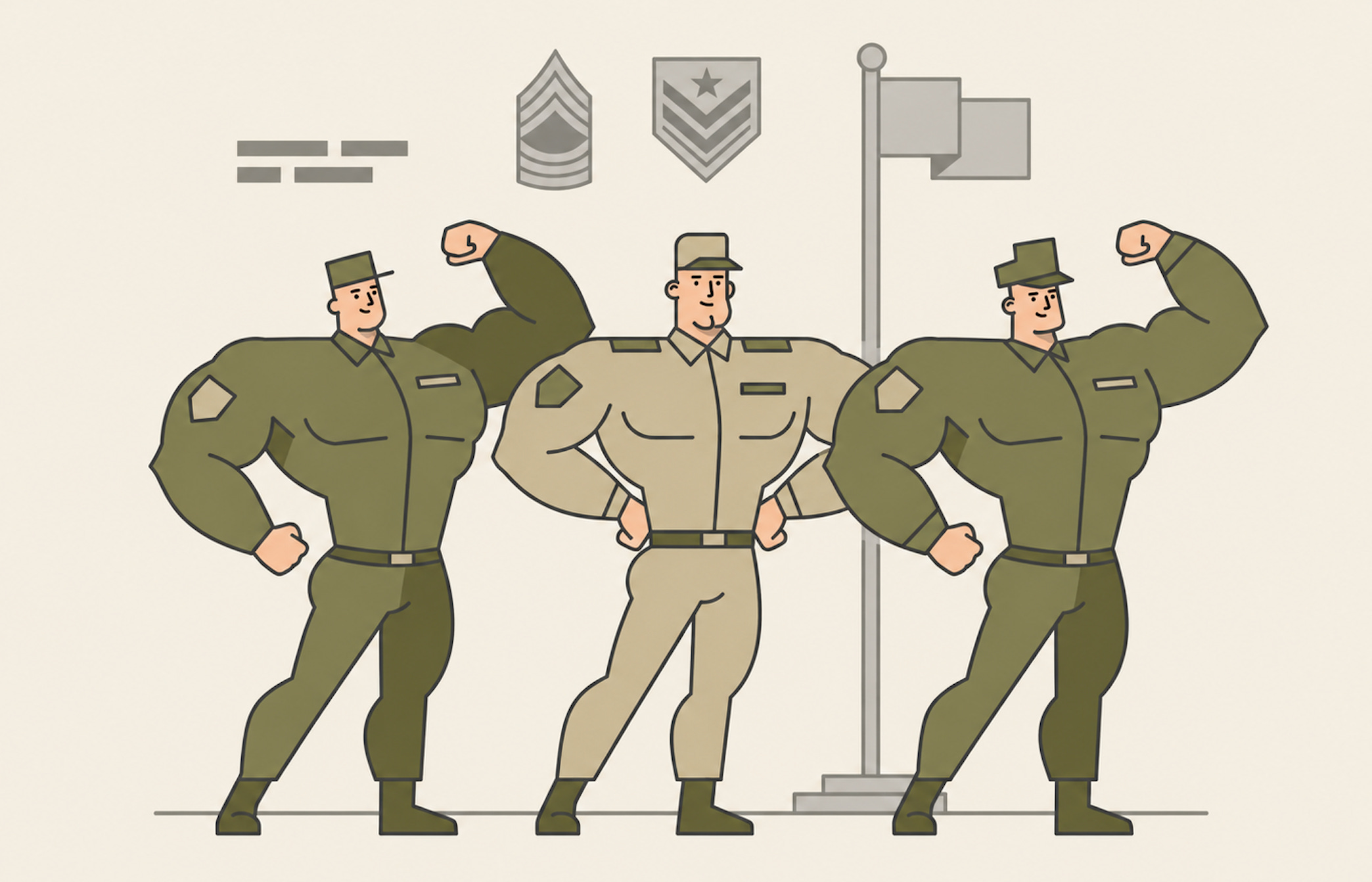
A prominent display of this insecurity has been Pete Hegseth’s “High-T Department of War” – an initiative to annually screen US service members aged 30 and over for testosterone deficiency and offer testosterone-replacement therapy where medically recommended, as part of his broader effort to maximise troops’ physical performance, resilience and their “lethality”.
Due to the volume of absurdities that emerge from the White House this dropped out of the new cycle without much scrutiny (which is, of course, the point), yet it was a development that highlights not only the pervasive status anxiety of modern men, but their odd predilections.
To the Trump administration – and the online swamps it swims in – national strength and the personal virility of individual men are one and the same. Men are meant to be warriors who exert their dominance and nations must do likewise. To be cooperative and conciliatory is to be a cuck. Unless you are constantly proving your manhood, the assumption must be that you don’t have any.
The renaming of the Department of Defense to the Department of War was due to the concept of “defence” being seen as wimpish and ineffectual. Real men are on the front foot. War is men taking action the way men should, and it is testosterone that is the essence of their power – the hormone of heroism, the biochemical of bravery, the secretion of superiority.
Yet, within this worldview, it is clear to see that men are fretting deeply about whether they are manly enough. Concerns about the testosterone levels of American servicemen has become a proxy for a wider cultural anxiety about masculinity, status and purpose.
Modern political institutions are viewed as increasingly feminine in both structure and values. Women’s education and advancement has been interpreted not only as encroaching on male domains, but creating a cultural shift away masculine virtues. Bureaucracies, universities, human resources departments and cultural institutions are portrayed as prioritising girly things like empathy, consensus and risk aversion over bold, decisive leadership and hierarchy.
Alongside this, falling testosterone levels, declining fertility and concerns about endocrine-disrupting chemicals are presented as evidence that modern society is weakening men. These biological concerns connect with culture anxieties to create a pervasive sense that masculine vitality is in decline, and civilisation itself with it.
It is only a High-T Department of War that can arrest this decline.
Yet like the culture it has emerged from this rebranding of the Department of Defense and its new High T policy is performative rather than substantive. It is the cheap clichés and stereotypes of masculinity – the weightlifting and the protein, the machismo and misogyny, and fantasising about the “warrior races” of the past – the Roman and Spartans. The louder this type of masculinity seeks to project itself, the more it demonstrates its underlying insecurity.
There is also something curious about this performance of masculinity, as it reveals not just how obsessed with masculinity certain men are, but how obsessed they are with other men. This performance of masculinity believes itself to be the height of heterosexuality, yet it is a dance performed for other men.
Elements of this are anthropological – men in the tribe needing to ward off outside men by puffing up their chests and grunting Tim Allen-style into the wind. Yet another part of it is uniquely modern, as it is men seeking the approval of other men. Men are not the audience for security, men are the audience to be impressed.
This is something both Helen Lewis and Kate Manne have identified within the “looksmaxxing” phenomenon – where young men seek to maximise their physical attractiveness. The assumption would be that this would be to attract women, but instead the objective is to prove to other men that you are capable of attracting women. Women are merely NPCs (non-player characters). Men are the main characters around whom all action revolves.
To understand the logical conclusion of this perspective it’s worth paying attention to one of the internet’s great weirdos – Will Blunderfield. Blunderfield sells himself as a “rewilding coach” – someone you hire to connect yourself to men’s primal, physical and sexual nature. He exists in the extremely online intersection of manfluencing, wellness, new age-ism, conspiracy, and absurd attention-seeking. He is fixated with the Spartans, the Samurai, and his “Celtic ancestors” – and especially these groups’ “ancient bro-bonding technologies”.
Everything that comes out of his mouth is pure bullshit, but there is one broader truth that he embodies where he is insightfully honest. To Blunderfield, the obsession with masculinity is unashamedly an obsession with men, and this obsession with men is sexual in nature. There is nothing more manly and High T than having sex with your “bestest bros”. And this is, indeed, how you prove yourself as a man.
Your masculinity is not legitimate unless it is recognised – physically, in its natural glory – by other men.
It is here we can also find the motivation of Pete Hegseth’s “High-T Department of War.” If masculinity is now a performance staged for the approval of other men, then the exhibition of war – with the department’s new name itself part of the performance – is simply this impulse conducted at the level of the state. This is distinct from a traditional Department of Defense, which implies a more restrained and responsible understanding of national interests.
The attempt to demonstrate this new High-T state posture through the war against Iran has proved how ineffectual this performance of masculinity is. Attempting to impress other men with a show of strength, the administration has instead been exposed as inept by the Iranians who were playing the game for real.
These are the consequences of a psychological shift created by an online environment where attention and the desperation for fleeting likes are more important than positive, long-term, real-world outcomes. It is a culture where symbolic displays of masculinity matter much more than strategy, planning and genuine capabilities, and where the fragile emotional needs of America’s leadership keep spilling into the machinery of the state.
And yet, the Trump administration has responded to their own weakness in the only way this culture knows how; with more bluster and buffoonery, convinced that they simply mustn’t have been beating their chests hard enough. They have never once contemplated whether it is the chest-beating itself that is their real problem.
🤮🤮🤮