

Last week a curious job advert appeared in my inbox. The Victoria state government here in Australia is looking for a Senior Adviser, Policy and Research (anti-racism). The job will be based inside the Policy and Research Branch of the Victorian Equal Opportunity and Human Rights Commission. A commission whose role it is “to help organisations better understand, prevent and respond to racism and race discrimination in a variety of settings.”
This all sounds like good stuff. Discrimination based on race is a scourge that humanity needs to transcend. On a superficial level “anti-racism” sounds like the antidote.
However, this is not the case. Instead the ideas it promotes are fast becoming the accelerant. And the state internalising its assumptions does not bode well for such a highly multicultural society as Victoria.
Anti-racism has emerged as a distinct set of ideas that are in direct challenge to the ideals of liberalism. Central to liberal ideals is that the individual is the primary moral and political unit, and that each person has equal rights and dignity independent of social status, class, race, or religion. Therefore, the law should treat each person as an individual bearer of rights and responsibilities, not as a representative of a collective group identity.
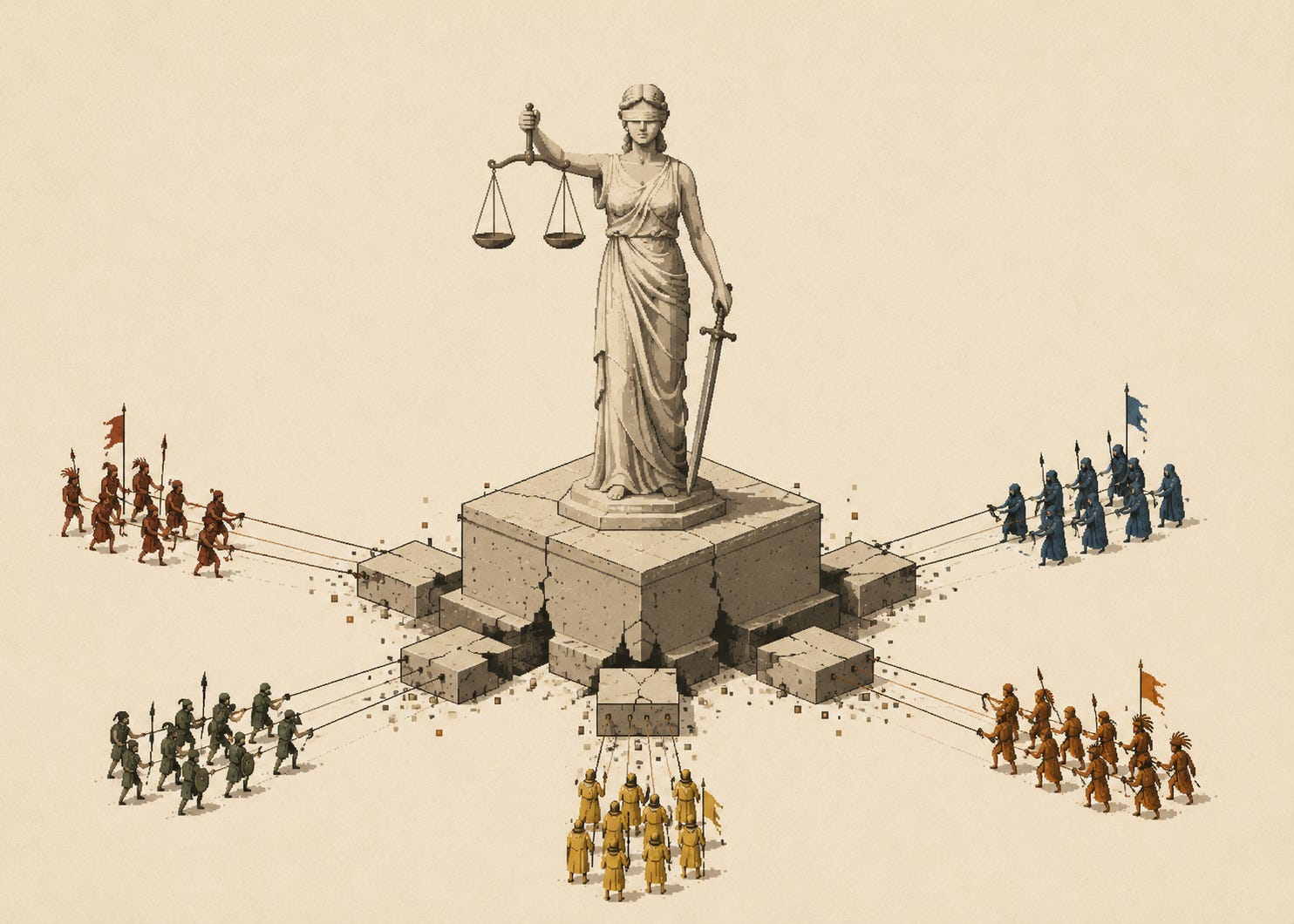
This is not what anti-racism believes. Instead anti-racism sees race as the primary moral and political unit that must be centred in all scenarios. It sees discrimination not as stemming from individual prejudice, but through persistent political or economic structures. It cynically believes that formally neutral rules are an illusion, that analysing society through group categories is essential to identify past injustice, and that organisations and the state should actively work to redress this past injustice through a series of privileges and hindrances (depending on the racial group).
Metaphysically, anti-racism believes that you are born with the historical inheritance of your skin colour, and you are permanently bound to the sins or victim status of it, regardless of what you do in life.
In the Hegelian view of History – that is, what is the world about? – anti-racism sees the world as a zero sum struggle between racial or ethnic groups. It believes that all social and political outcomes are due to this struggle. Here it holds the exact same view of History as white supremacists. Just because anti-racism sees itself working to reverse racial hierarchies this is not a repudiation of the concept of racial hierarchies.
Because anti-racism has now embedded itself within progressive politics (or politics that believes itself to be progressive), it is important to consider the structural conditions that have led to its emergence, how it is capturing states throughout the West, and why it will produce outcomes that are the opposite of what it claims are its intent – and what should be the intent of a body like the Victorian Equal Opportunity and Human Rights Commission.
New ideas don’t institutionalise themselves; they require structural conditions that reward, amplify, and absorb them. To understand why ideologies like anti-racism are increasingly migrating from activist discourse into bureaucratic roles we need to comprehend current structural incentives within Western societies, and for this it is useful to consider the work of Peter Turchin.
Turchin began his career as a zoologist, studying population dynamics in animals; his work sought to understand how complex biological systems rise, fluctuate, and stabilise over time. However, he got bored with animals and turned his attention to studying human history; developing a theory about how societies rise and collapse, and what were the common conditions that lead to collapse.
Turchin’s thesis has been that societies start to fracture and collapse when its elites begin turning on other elites, and, by extension, the prevailing political systems. He has termed this as “elite overproduction” – where competition between über-elites intensifies, and when there are too many garden variety elites to be absorbed by well-paid or high status jobs. The resentments of both these scenarios start eroding societies.
The first cohort is today’s most recognisable problem. Who I’ve called über-elites are those Turchin refers to in their current behaviour as “counter-elites”. These are people of enormous privilege who – counterintuitively – strive to dismantle the systems that have provided them with this privilege in an attempt to exert even greater power.
The obvious modern examples are Donald Trump, Nigel Farage and Elon Musk. Trump has the most powerful and high status job in the world, and Musk is the wealthiest person on the planet. Yet alongside the rapacious competition they see themselves in with other powerful and wealthy people, what they don’t have is the respect of people with class and taste – which is what they actually crave. As a result they are attacking – and now capturing and eroding – political and social institutions as a form of petulant revenge.
The second type of intra-elite competition is more complex, but it is where we find the mechanics of how radical ideas become institutionalised.
Due to the significant increase in education over the past 50-60 years, there is now far greater competition for well-paid and high status jobs, and often not enough to go around. This is creating social turbulence.
Instinctively, I hate this idea, because one should never be suspicious of education and we absolutely should be striving towards having highly educated societies. The idea that we require a subaltern class without knowledge and capabilities is a repulsive one.
Yet, there is a recognisable issue here.
Educated people quite rightly expect that the efforts they’ve made to obtain degrees should come with the reward of jobs and social recognition that reflect these efforts. Yet without enough well-paid and high status jobs there are now strong incentives for individuals to differentiate themselves through more radical ideas as a way of obtaining influence and status within their societies. This is compounded by one of the central psychological pillars of progressive politics – that there is always a more radical position, and this more radical position is morally superior by default.
There’s a recognisable pattern in how these ideas develop and expand. Activists and intellectuals often distinguish themselves within movements and institutions by pushing arguments further, seeking attention, legitimacy, or moral authority. As earlier demands become normalised or partially institutionalised, the baseline shifts, creating incentives to identify new injustices or reinterpret existing ones in broader, more systemic terms.
Group polarisation and moral commitment reinforce this dynamic. Like-minded networks reward stronger signalling of conviction, while moderation risks being framed as complacency or complicity. Gatekeepers emerge to prescribe the “correct” language, periodically redefining language in ways that sustain their authority and weed out heretics. Emotional drivers – outrage, moral certainty, and identity investment – deepen the attachment to more radical positions, so that scrutiny of ideas can come to feel like betrayal rather than good faith debate about which political and social arrangements genuinely improve the human condition.
Due to elite overproduction, the state has felt the need to absorb some of this larger educated cohort and this has led to this process of radicalisation advancing into the bureaucracy. This has expanded the role of the state to be more active in social issues – areas where in liberal societies its role should be limited. This has also aligned with another progressive impulse – that for a society to value something the state has to do it.
This dynamic helps explain why the Victorian government is advertising for a Senior Adviser, Policy and Research (anti-racism). However, roles like this create an internal tension within a liberal democratic state: its constitutional framework and commitment to the rule of law rest on universal principles applied equally to individuals, while parts of the bureaucracy are tasked with advancing perspectives that are sceptical of that universalism. The result is a structural contradiction, in which institutions designed to administer neutral rules now advance ideas that prioritise group-based interpretation.
When a political framework places a strong emphasis on racial identity it encourages people to interpret themselves and others first and foremost through racial categories rather than as individual citizens – or, to judge people by the colour of their skin, and not the content of their character. When this framework dominates the public discourse it atomises society, dissolving the broader national and civic commitments that plural societies need to maintain cooperation.
Those who are already predisposed to grievance politics respond by tightening their attachment to group identity, drawing sharper distinctions between groups, and interpreting all social changes as attacks on their identity group. Such thinking is the primary psychological driver of conspiracies like the great replacement theory. These people thrive on racially essentialist thinking; the idea that racial groups are coherent, fixed, and politically primary.
Progressive politics is currently playing right into their hands, and so we are seeing a far more open and aggressive form of racism within Western countries. This has emerged because of another little quirk in progressive psychology. To progressives, the internal rule that “everyone is allowed to organise themselves politically by racial groups, except white people” makes sense. The West’s historically dominant group should “check its priv” and not exert itself politically the same way as minority groups. But white supremacists don’t play by these internal progressive rules, they see the encouragement of racially-based political organisation and recognise it as an opportunity to do likewise.
This relates to another eternal oversight of progressive politics – the impulse to create bureaucratic structures without considering how they could be used nefariously. Currently in Australia there has been a surge in polling support for the anti-immigration One Nation party. Do we really want a web of bureaucratic structures and data focused on race to be in the hands of a party whose leader has recently said “how can you tell me there are good Muslims?”
There’s a reason why regimes like the Nazis or Apartheid South Africa were obsessed with collecting racial data, and it wasn’t so they knew which important cultural dates to acknowledge. Central to liberalism must be the awareness of not concentrating too much power in the state because you never know who is going to use that power. Although France clearly has its political problems at the moment, its refusal to collect census data on race or religion is a demonstration of the state’s commitment to universalism over identity. Most importantly, this is also to prevent vicious political movements from having a tool at their disposal should they win political power.
Anti-racism is built on a belief that institutions and governments need to actively work to “rectify history”. The problem is that bureaucracies rarely do temporary measures. Max Weber recognised that bureaucratic structures become self-perpetuating, they operate on rules and process, and so can be hard to reform and difficult to dismantle once established. Even if history could be rectified – an absurd notion – these race-focused bureaucratic structures would not wilfully disassemble.
To be concerned about the centring of race in political discourse and bureaucratic structures is not the same as being suspicious of different cultures. Melbourne is one of the most diverse cities in the world and it’s a truly brilliant place to live because of this. Due to my staunch belief that food starts in Kabul and heads east, this is particularly advantageous for me.1
But multiculturalism at a civic level only works if there are a broader set of social commitments that can act as a binding agent. For this, the state needs to embody universalism – meaning the law and its policy frameworks dispenses no favour or discrimination to people based on racial or religious group. Universalism is what allows cultural difference to exist within a shared political framework; it ensures that diversity operates within common rules rather than competing systems of recognition.
When this principle weakens, tensions emerge not only at the level of theory but in the everyday lives of non-majority communities. The ideological assumptions of anti-racism often conflict with how these groups see themselves. Many do not want to be treated as symbolic constituencies rather than individuals with their own views and priorities. They may have left highly hierarchical and group-centric countries precisely because they value the egalitarian and liberal nature of Australia and want to participate fully in it. That aspiration can sit comfortably alongside pride in their cultural heritage. It reflects the complexity of human identity – a complexity that both racists and anti-racists struggle to accommodate.
I hope that my critique here will not be conscripted into the unhinged anti-Victoria narrative that now animates conservative politics in Australia.2 There is no grand conspiracy here, no coordinated descent into illiberalism directed from Spring Street. What we are seeing is something at once more mundane, but potentially more troubling: a government not thinking carefully enough about the ideas it absorbs and the language it legitimises.
The problem is not ideological intent but intellectual complacency – a failure to properly interrogate fashionable concepts before embedding them in policy, a lack of discernment about which voices are influential, and an inattention to the structural incentives that quietly push institutions in illiberal directions. The machinery of self-scrutiny that should discipline government decision-making is faltering. And it is this lack of judgement – especially on issues of race – that has the potential to become incredibly dangerous.
The one exception is Ethiopian food which is not east of Kabul, but still incredible. But you get the gist. I exist mostly on Indian and Thai food. The two food groups.
Because the Liberal Party has only won one election in Victoria this century, much of the conservative media and various politicians have constructed this batshit narrative that Melbourne has become a cross between Pyongyang and Mogadishu as an incredible cope. The irony is that this will only lead to the Liberal Party continuing to lose elections. Although I suspect, to fuel their angertainment, this is exactly what these clowns want.
This is very well articulated in terms of the dynamic between individual rights and group rights.
I'd suggest part of the broader problem is multiculturalism itself and how multiculturalism facilitates group based identities, group based interests and group based rights.
I'd suggest another progressive blindspot is that group based identities, group based interests and group based rights naturally leads to group based racism with cultural groups demarking themselves from other cultural groups. This exclusionary practice is racism on a spectrum from soft to hard so in my opinion, saying that "white" cultural groupings are inherently racist whilst "nonwhite" cultural groupings aren't is a further contradiction to resolve.
Clearly if all demarcated cultural groupings are inherently racist then supporting the material, social and cultural interests of particular cultural groupings isn't anti-racism but racism which is why progressive "anti-racism" fuels an equal and opposite effect.
So in terms of your article, the Victorian State Department is actually endulging in racism unless it can show that it is prioritising individual rights over group rights (liberalism) or is demonstrating neutrality over a field of competing cultural groups (multiculturalism).
This highlights that liberalism and multiculturalism is incompatible and that group identity should always be considered as a second order identity to individual identity. The question is how do you separate the two when an individual identity is centred on a group identity as is often the case with devout religious attachment.
This highlights the meta problem in terms of blank slatism as is often implied in liberalism with abstract principles like dignity and equality being the focus but dignity and equality in relation to what beyond the atoms and molecules of the human organism.
As your article points out, much of anti-racism discourse is about thwarting the formation of "white" cultural groups whilst simultaneously protecting and facilitating the formation of "nonwhite" cultural groups and ones usually based on religion. This clearly isn't dignity and equality in action but the two-tier use of these abstract principles to justify and institutionalise group based racism.
In other words, if "whites" can't form demarcated cultural groups, why should "nonwhites" be able to. Thus if we want a liberal universalism based on dignity and equality, then group based identities should not be protected by the State and their formation should be discouraged.
If multiculturalism is the State's intention, then all group identities should be shown dignity and equality.
In both case, progressives are failing dismally and seem to be intent on dismantling the social fabric of societies so that they can "manage" the chaos they are intent on creating as a means to becoming the new elite class. That perhaps explains why the ideology of wokeism is demonstrably failing both culturally and politically.
You might be interested that in the UK, Stella Tsantekidou is trying to rectify the inherent contradictions of Progressivism. She has a Substack too.