

Passions usually have their roots in that which is blemished, crippled, incomplete and insecure within us. The passionate attitude is less a response to stimuli from without than an emanation of an inner dissatisfaction.
The Passionate State of Mind - Eric Hoffer (1955)
Donald Trump and his administration have clearly signalled their intent to operate without restraint. Trump himself informed the New York Times last week that his power will only be restrained by his “own morality”. Which, given he is a civilly liable sexual abuser, an attempted coup instigator, and a compulsive liar (as the tip of the iceberg) shouldn’t instil the world with confidence.
His deputy chief of staff, and the administration’s prime psychopath, Stephen Miller, expanded on this theme in an interview with CNN’s Jake Tapper by stating bluntly: “We live in a world, in the real world, Jake, that is governed by strength, that is governed by force, that is governed by power. These are the iron laws of the world that have existed since the beginning of time.”
What the administration has articulated, through both its actions and its words, is an explicit worldview. One that is built around their own power and ability to exercise it at will. The constraints of laws, of constitutions, of personal ethics, and the realities of what we see with our own eyes, are all dispensed with. Instead the governing principles are the dark passions of humanity: anger, hatred, resentment, deception, and the urge to dominate. These passions are being exercised through the spectacle of violence. With both the spectacle and the arbitrary nature of it designed to cower people and leave the administration without challenge.
What the Trump administration is engaged in is domestic regime change. Plato’s original concept of “regime” was the ideas, form of government, the constitution of a society, and – most importantly to understand the MAGA movement – the moral character of the citizenry.
In less expansive terms, in modern Western countries the regime is liberal democracy. Governments may be won by different parties, with different platforms and policies, but the constitution – and the ideas it embodies – doesn’t change with election results.
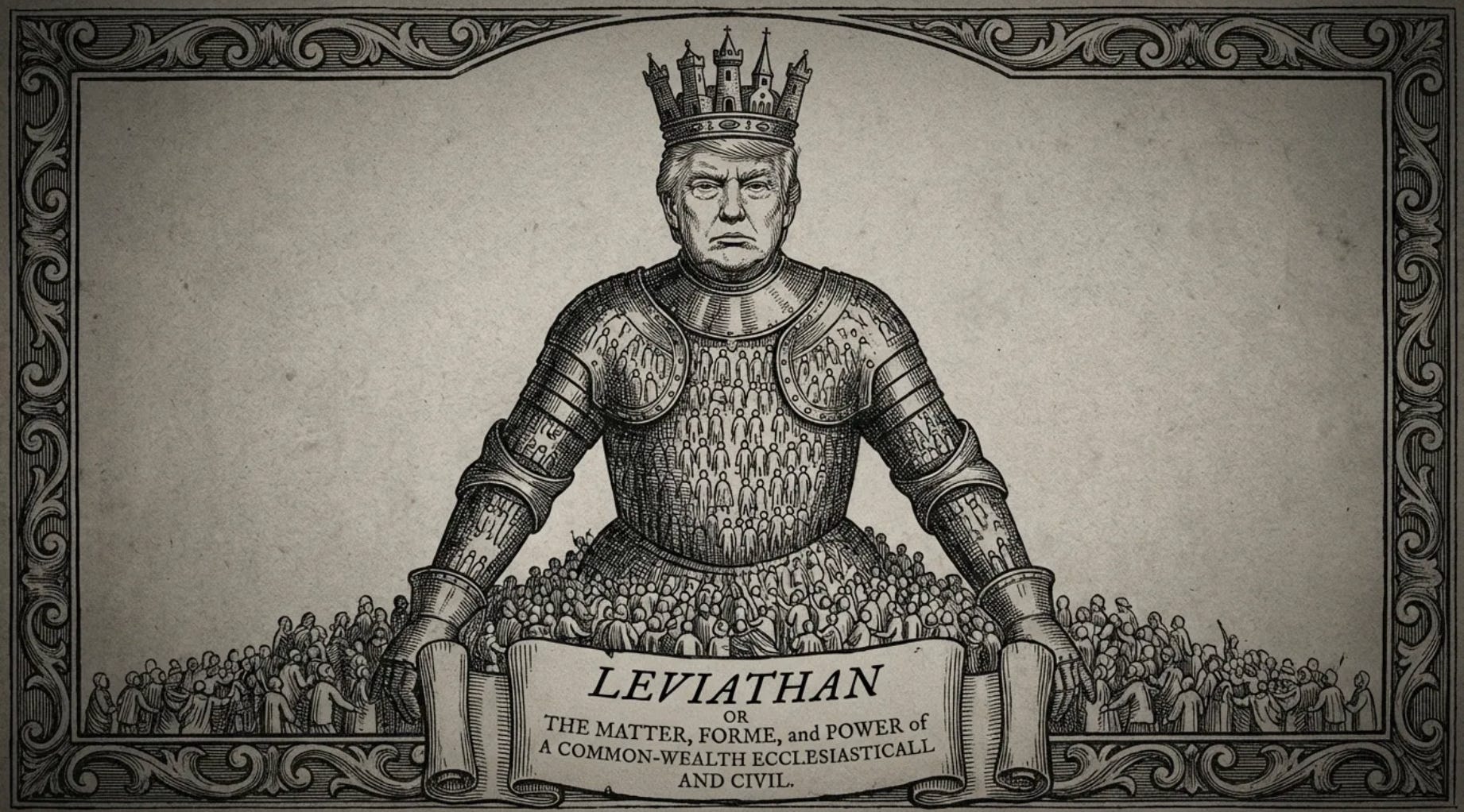
Until Trump’s second term, the regime of the United States had been liberal democracy. Now the country is in regime purgatory. Given the decentralised nature of the country, and its muscle memory, much of the U.S still functions as a liberal democracy, however the office of the presidency is attacking and overthrowing its tenets by the day. Attempting to install a new authoritarian regime. With Trump as its emperor.
To understand the worldview of the administration there is a need to return to the philosophical thought experiments of humanity’s “state of nature”. Or, “the iron laws of the world that have existed since the beginning of time”, as Miller aggressively put it. Were Miller a curious man, he would know that these laws aren’t iron, but both debatable and complex.
Trump is often understood as a Hobbesian creature. A brutish beast mired in vainglory who only understands the world in terms of his own advantage. Without a strong sense of order, Thomas Hobbes believed that these creatures would roam the Earth creating a permanent insecurity and a “war of every man against every man.” For Hobbes these dark impulses were an innate feature of humanity and political structures needed to be devised to restrain them. Rational individuals would therefore relinquish some personal freedom to a powerful sovereign to establish mutual safety.
Unlike Hobbes, John Locke believed that humans had greater moral capabilities. Behaviour was not inherent, but was formed. Character was developed from experience, reflection and guidance. Through positive education and experience, humans could be ethical agents capable of governing themselves through reason. As an extension of this, a character-bound population was necessary to create a virtuous government.
Locke was the most influential philosopher on America’s founding documents and the broader American project. And it is through Locke where we can see Trump’s regime change, in both the direct and expanded Platonic sense. To Locke, virtue lay in one’s own self-command – the ability to govern one’s desires, and to act with long-term rational judgement, not immediate impulse. Restraint and deliberation were the foundations of moral character. Things Trump and his acolytes clearly struggle with.
Which is why it might be Jean-Jacques Rousseau who reveals more about the nature of the Trump administration. Rousseau believed that humans in their state of nature were not motivated by dark impulses, but instead were fundamentally innocent and naturally virtuous. This may not seem Trumpian, but Rousseau thought that the corruption of humanity lay in the social institutions people were subjected to. That the social “chains” we see as civilisation actually restrained humans from being their true, authentic, selves.1
Rousseau himself was a scumbag. He had an extraordinary talent for quarrelling, falling out with many of his contemporary thinkers. He also fathered five children, all of whom he dumped in a foundling hospital in Paris due him considering them a burden on his freedom. In practice, he saw his freedom of action and pursuit of authenticity as his primary interest. Rousseau rationalised his personal failings as moral principles.
The Trump administration’s state of nature takes inspiration from both Hobbes and Rousseau. It believes that humans are guided by dark impulses, but that social and political institutions have no right to restrain these impulses. They believe that the institutions of liberal democracy – and modern social mores – are corrupting, and the only way for humanity to be its authentic self is for it to manifest a dog-eat-dog world. Where they are the biggest and hungriest dogs.
Like Rousseau, the Trump administration is centring their own personal failings as both a set of principles, and as a political project to fundamentally change the country, as well as the global order. The aggression of the administration – and the broader MAGA movement – is driven by modern men’s grim fragility. The status sensitivity, wholesale defensiveness, anxiety about appearing weak, the puffed chests, belligerent rhetoric, and obsession with the most vulgar and clownish masculine stereotypes.
These traits highlight the deep emotional insecurity that is at the core of authoritarianism. Trump’s relentless narcissism is not confidence. He may be shameless, but this disguises his brittle self-esteem. On some level he knows that he is a profoundly ignorant and grotesquely flawed human being. He overcompensates for this with bluster and brutality. Hoping that this will cower into submission those who could expose his flaws. It has worked perfectly on the Republican Party.
Those who lack the personal capabilities to navigate the world with compromise and cooperation, only understand the world of dominance and subordination. Either you are dominating people, or you are being dominated by them. The concepts of character, friendship and trust are beyond their comprehension. It’s also why something like a country’s constitution is so inconceivable to Trump. Constraints on the use of power are for suckers. But constitutions also expose him to legalities that he knows he cannot meet.
At the core of dominance lies a low tolerance for uncertainty. Ambiguity is experienced as threat and complexity as chaos, so the world’s multiplicity provokes fear rather than curiosity. This mindset seeks psychological safety through control: by trying to make the external world rigid and predictable, it compensates for internal emotional disorder. Where self-regulation, adaptability, and persuasion feel out of reach, domination becomes a substitute.
Force becomes appealing because it negates uncertainty quickly. It creates immediate, tangible outcomes, even if those outcomes are destructive or fragile. The logic of the Trump administration is that it can use the power of the White House in a way that can calm their anxiety over uncertainty. The problem is that the world is far more complex than just who has the biggest fist, and what Trump is doing is creating greater uncertainty, not less. Which may then inspire a greater use of force.
The struggle to understand and tolerate complexity is what leads authoritarians to hold a zero sum worldview. In each transaction between people or countries one party must win and the other must lose. There is a deep cynicism towards the possibility of mutual benefit. The notion of cooperation is both naïve and risky. The potential of being the loser inspires preemptive aggression. With this aggression being seen as rational, even virtuous, because it prevents imagined losses.
This zero sum worldview is also central to the authoritarian preoccupation with hierarchies. For the Trump administration the calculation is quite simple – the U.S is the most powerful country therefore all other countries should bow in submission to it. Domestically there is an inability to emotionally cope with the natural pluralism of the U.S, which is why the White House’s fist is also directed inward at American society.
That all people are created equally and endowed with certain inalienable rights is unfathomable to authoritarians. Instead there is the need to create in-groups and out-groups, to rank groups by favour and animosity, and reject wholesale any individual agency outside of group status. Obedience to group status and hierarchical position is expected, and any divergence is met with fierce hostility. Order is only understood as strict compliance with the demands of the apex group. Not through anything as “beta” as cooperation and trust.
Power, and the ability to exercise it, is seen as the only form of legitimacy. The violence that White House is currently radiating is held to be a pure expression of humanity. Deliberation, discussion, negotiation, policy, laws and process are all deemed to be artificial. They are not just impediments to the impatient, but are considered to be impositions on an authentic and effective form of human action. Real men act with force. They don’t draft anything for circulation and input.
The thrill of violence also serves as a bonding mechanism for the in-group. It demonstrates the risk of dissenting from the group, creating mutual assured incrimination to maintain loyalty and build cohesion. Violence also becomes a rite of passage. Being recruited by ICE to be one of the administration’s jackboots is now the highest form of honour for MAGA diehards.
An aggressive demeanour is also an attempt to reverse humiliation. Trump has never gotten over being deemed too uncouth for Manhattan high society. His administration collectively views Europeans as the same cultural elites who they crave acceptance from and then lash out at because they’ll never receive it. Their belligerence is an attempt to demonstrate how weak cultural refinement is in the face of boorish intimidation.2
The suspicion of NATO, the aggression against Denmark, the support for parties like the Alternative Für Deutschland, is all driven by their sense of humiliation and a belief that undermining the liberal democratic architecture of Europe will restore their personal dignity.
Of course, this undermining of liberal democracy in Europe is also designed to build a network of supplicant authoritarian states who will not adhere to the ethical and legal standards of liberal democracy, not create laws that constrain the administration’s friends (like tech companies), and who will know their place in the hierarchy.
Trump is obviously hostile to the restraints of liberal democracy, and will no doubt do whatever he can to prevent this year’s mid-term elections from running smoothly and fairly. However, the broader Trumpian revolution is the attempt to overthrow the country’s moral character. To refashion the country in the administration’s own image – malicious, corrupt, domineering, deceitful, ignorant, myopic, emotionally insecure, erratic and irresponsible.
The Trump administration are acting this way because they imagine that they can. They’re in thrall to the potency of the White House and assert that the purpose of the office is to wield its awesome power. Yet raw power is not as straight-forward as those who hunger for it believe. The intense polarisation of American politics may have protected Trump from his previous coup attempt, but those who unleash barbarity tend to eventually have it swing back towards themselves.
Rousseau also created the conceptual conditions for postmodern progressive politics. With his ideas about the state of nature driving much of the “decolonisation” movement through the narrative of the “noble savage”, as well as the obsession with authenticity of identity politics.
Trump’s renaming of the Kennedy Center is also part of his revenge against cultural elites. The idea is to capture the centres of artistic excellence, not to be a patron to their work, but to infect them with his stink.
Trump seems very Stalinesque with the in-group ideas. Very dangerous and without virtue. It didn’t end well for the USSR and it won’t end well for the U.S. As plain as the nose on his face.
Good overview of foundations, while one can see directly the present pillars that guide Trump, a narcissist who seemingly acts erratically on the moment, but is following a plan.
Present symptoms supported by fossil fuels and oligarch donors, include Koch Network Heritage Foundation's & Tanton Network Project2025 as guiding the Trump administration; personified by OMBS Russell Vought (Koch Network) and Policy Advisor Stephen Miller respectively (Tanton Network), with Fox News doing the PR & comms (both Networks inform content).
Coincidentally, Heritage is partnered with the anti-EU and anti-Ukraine Budapest Danube Institute supported PM 'mini Putin' Orbán, where Fox Board's Tony Abbott is a visiting fellow & his invisible 'international advisor' too (apparently?).
Heritage, according to the NYT May '25 also developed, with input from Israel, of the Orwellian anti-anti-semitism Project Esther vs Palestine, universities, free speech and centrists (reliving the late Weimar era?) and before Xmas in US it's head Kevin Roberts was accused of ignoring anti-semitism....after his non response to the infamous Carlson-Fuentes interview.....personnel ran for the exits......
This complex transnational picture has been described by 'Dark Money' author and New Yorker's Jane Mayer as 'architecture of influence' and all elements of influence exist onshore in Australia.